Article partially generated by artificial intelligence.
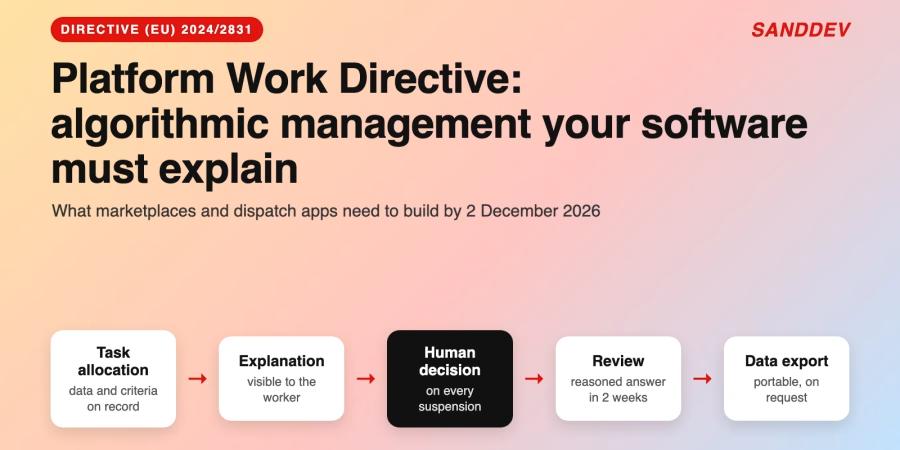
TL;DR: The Platform Work Directive, Directive (EU) 2024/2831 on improving working conditions in platform work, must be in national law by 2 December 2026. It presumes employment where an app directs and controls the work, and it limits what algorithms may do to everyone who works through a platform, the self-employed included: no banned data, a human behind every account suspension, written reasons and an answer to a review request within two weeks. For marketplaces, ride-hailing, delivery and dispatch software this means five features: an explanation panel, human sign-off on suspensions, decision logs, exclusion of banned data and worker data export. Sanddev, a software house in Wrocław, Poland, reviews and builds these parts of platform software.
The directive was adopted on 23 October 2024 and published in the Official Journal on 11 November 2024. Member States must transpose it by 2 December 2026 (Article 29).
More than 28 million people work through digital labour platforms in the EU, according to the Council of the EU.
The algorithmic management rules in Articles 7 to 11 protect every person performing platform work, including the genuinely self-employed.
The Platform Work Directive is the EU law on working conditions in platform work. It does two things. First, it creates a legal presumption that a person is an employee when the platform directs and controls their work, and it puts the burden of proving otherwise on the platform. Second, it regulates algorithmic management: the automated systems that allocate tasks, set prices, evaluate performance and restrict or close accounts.
The directive defines automated decision-making systems broadly. They include systems that decide on the allocation of assignments, on earnings, including the pricing of individual assignments, on working time, and on the restriction, suspension or termination of an account. If your dispatch engine, surge pricing or rating model touches any of these, it is in scope.
The algorithm is also evidence. When a court or a labour inspector checks whether someone is an employee, the facts that count include “the use of automated monitoring systems or automated decision-making systems” (Article 4(2)). The way your software allocates, ranks and sanctions people is the first thing that will be read.
Who the Platform Work Directive covers: platforms, fleet partners and the self-employed
A digital labour platform is a service that is provided at least partly online at the request of a customer, involves the organisation of work performed by people for pay, and uses automated monitoring or decision-making systems. Ride-hailing, food and grocery delivery, cleaning, home services and many freelance marketplaces fit that description.
Workers and the self-employed. Chapter III, Articles 7 to 11, applies to all persons performing platform work. The health and safety and consultation duties in Articles 12 to 14 apply to platform workers only.
Intermediaries. People engaged through an intermediary must get “the same level of protection” as those contracted directly, and Member States may introduce joint and several liability (Article 3). In Poland this is the fleet partner model used in ride-hailing. The explanatory memorandum to the Polish draft names it explicitly, and the draft makes the platform and the intermediary jointly liable and requires them to agree how drivers exercise their algorithmic rights.
Business users. The right to human review in Article 11 does not apply to business users within the meaning of the P2B Regulation, such as restaurants selling through a delivery app.
Platform Work Directive deadlines and the Polish draft act
Date
What happens
11 November 2024
Directive (EU) 2024/2831 published in the Official Journal
2 December 2026
Transposition deadline for all Member States (Article 29)
November 2026
Polish draft act UC160 in inter-ministerial agreement; no date for adoption by the government
End of 2026
European Commission proposal for a Quality Jobs Act, with algorithmic management among its priorities
2 December 2027
AI Act obligations for high-risk employment systems (Annex III) apply, after the Digital Omnibus postponement
Every two years
Evaluation of the impact of automated decisions, with workers’ representatives (Article 10(1))
A late transposition does not buy much time. The GDPR already applies to automated decisions about drivers and couriers, and the record fines so far were imposed under it. The Polish draft published on 6 August 2026 adds national detail: a labour inspector can declare an employment relationship if the platform does not rebut the presumption within 14 days, a human must take any decision to suspend or close an account, the platform must answer a review request within two weeks, and a person who asks why the cooperation ended must get an answer within seven days. The draft enters into force one month after publication, so the build work cannot wait for the final text.
What data your algorithm can no longer use
Article 7 bans six kinds of processing by automated monitoring and decision-making systems, from the recruitment stage onwards and for any system that takes or supports decisions “in any manner”. A platform may not:
process personal data on the emotional or psychological state of a person,
process personal data from private conversations, including with other workers and their representatives,
collect any personal data while the person is not offering or performing platform work,
process data to predict the exercise of fundamental rights, such as joining a union or collective bargaining,
infer racial or ethnic origin, migration status, political opinions, religious beliefs, disability, health, emotional state, trade union membership, sex life or sexual orientation,
process biometric data to establish a person’s identity by comparing it with stored biometric data of many people.
In product terms this removes sentiment analysis of driver chats, reading in-app messages between couriers, location tracking after a shift ends, fatigue or mood scores derived from behaviour and one-to-many face matching. Selfie checks that compare a face with one stored photo are not named in the ban, but they need a legal assessment. The Italian data protection authority fined Glovo’s Foodinho EUR 5 million in 2024 partly for facial recognition and location tracking outside working hours.
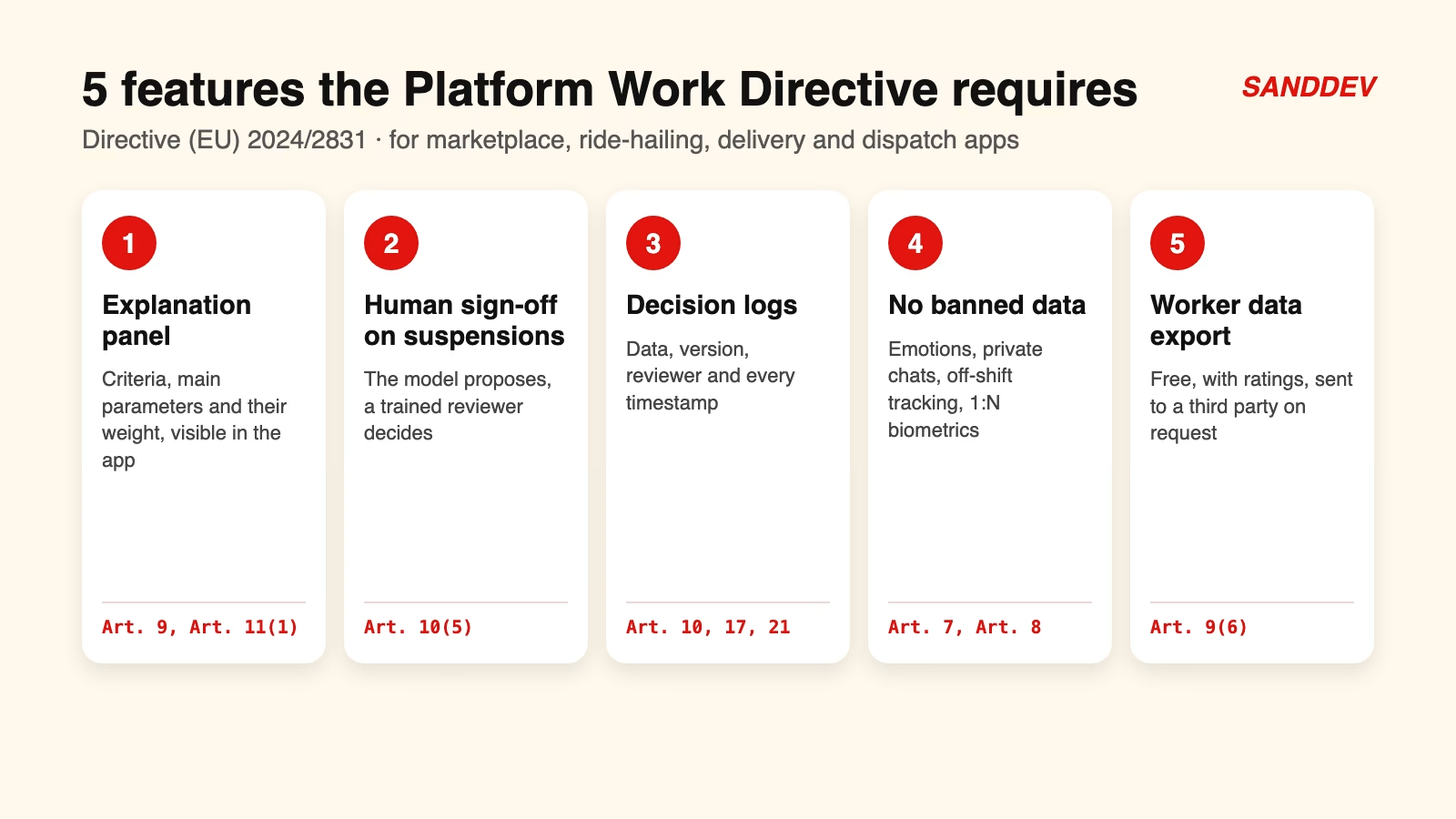
Platform Work Directive compliance: 5 features every marketplace and dispatch app needs
These five features follow directly from Articles 7 to 11. Each one is a piece of software, not a policy document, and each one can be reviewed in the code.
1. A panel that explains the algorithm’s criteria
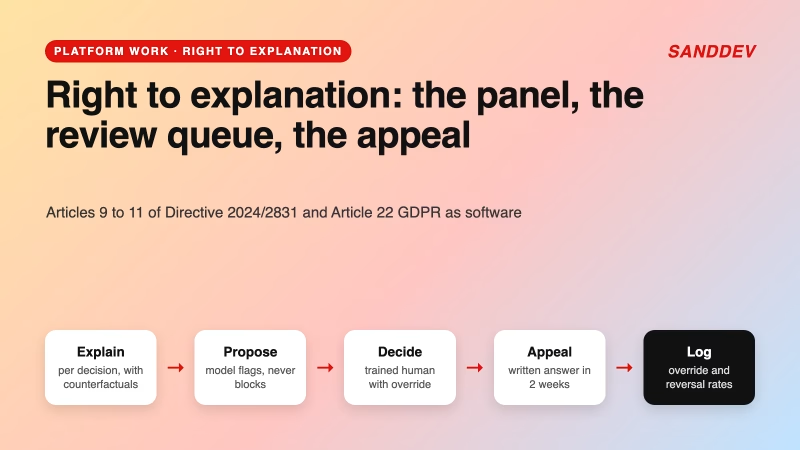
Article 9 requires platforms to tell people which decisions are automated, which categories of data and main parameters the systems use, with their relative importance, and the grounds for restricting, suspending or closing an account or refusing payment. A concise version goes to each person no later than their first working day, before any change and on request; a full version goes to workers’ representatives and to authorities. Article 11 adds an explanation of any significant decision without undue delay, with a named contact person.
a versioned transparency document generated from the system configuration, not written once and forgotten,
an in-app “why did this happen” screen for allocation, price, rating impact and account status,
notifications before any change to parameters or weights,
routing to a contact person who can discuss the decision.
2. A process in which a human approves suspensions
“Any decision to restrict, suspend or terminate the contractual relationship or the account” must be taken by a human being (Article 10(5)). The people doing this need competence, training and the authority to override the system, and protection from dismissal for doing so. The Dutch authority’s fine against Uber concerned exactly this: accounts deactivated automatically on suspicion of fraud or for low customer ratings. A reviewer who clicks “confirm” on whatever the model proposes will not pass that test.
the model may only propose a restriction; the account action itself requires a reviewer’s decision,
a review queue with the evidence the model used and the option to reject it,
a written statement of reasons delivered no later than the day the decision takes effect,
a review workflow with a two-week deadline (Article 11(2)) and correction or compensation within two weeks when the decision was wrong (Article 11(3)).
Uber already runs a review process for deactivations in Poland, but it does not publish a response time. The directive turns that into a measurable service level.
3. Decision logs
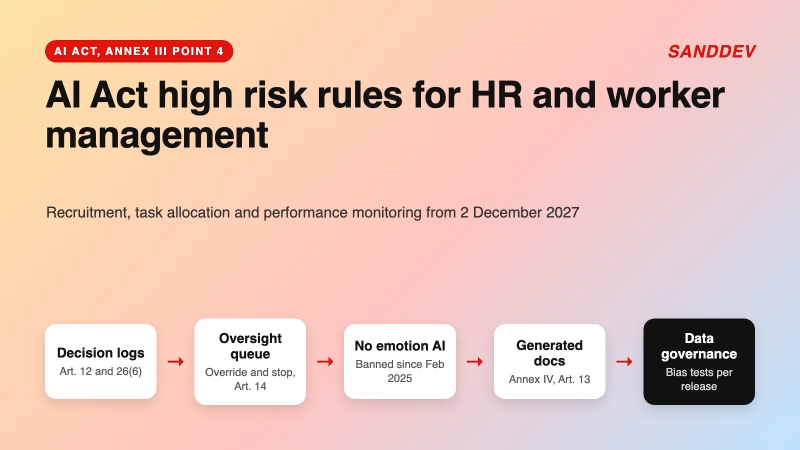
The directive does not have a separate article on logging, yet you cannot meet it without one. The two-year impact evaluation (Article 10), information for authorities and representatives updated at least every six months (Article 17) and disclosure of evidence in court (Article 21) all depend on a record of what the system decided, why and who confirmed it. For high-risk AI systems, deployers must also keep logs for at least six months under Article 26(6) of the AI Act.
an append-only event per decision: data categories used, rule or model version, parameters and weights,
the proposed outcome, the final outcome and the reviewer who took it,
timestamps for the decision, its effect, the statement of reasons, the review request and the answer.
4. Exclusion of banned data
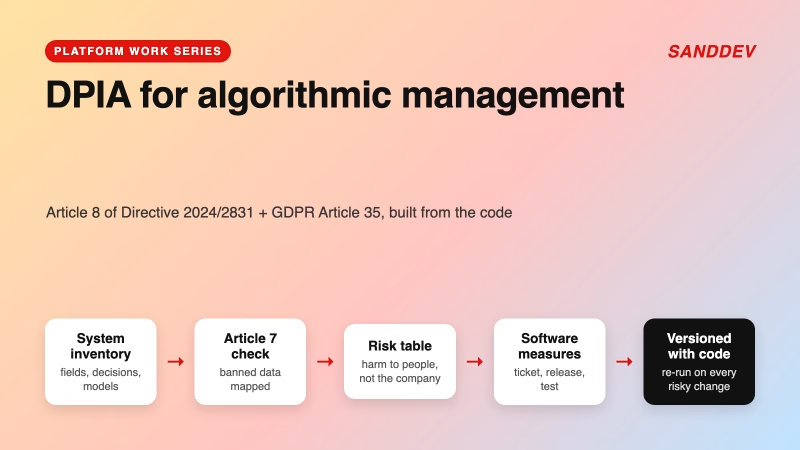
Article 7 is enforced at the data layer. Article 8 treats processing by these systems as high risk under the GDPR, so a data protection impact assessment is mandatory, the people concerned must be consulted and the result shared with their representatives.
an inventory of every field that reaches a monitoring or decision system, mapped to the six bans,
location collection that stops when the person goes offline,
automated tests that fail the build if a banned field reaches a model or a rule,
a DPIA built from the same inventory rather than from interviews.
5. Worker data export
Article 9(6) extends portability beyond the GDPR to data generated in the automated systems, “including ratings and reviews”. The platform must provide free tools and, on request, send the data directly to a third party, such as another platform.
a self-service export in a structured, machine-readable format, including rating history,
an API or transfer process to another platform or a representative on request,
the same export for people engaged through a fleet partner, which needs data exchange between the two systems.
Platform Work Directive requirements mapped to software
Requirement
Article
What to build
No processing of banned data categories
Art. 7
Data inventory, collection cut-off after shifts, CI checks on model inputs
Impact assessment and consultation
Art. 8
DPIA generated from the data inventory, shared with representatives
Reviewer queue with override rights, evaluation reports from logs
A human decides on restriction, suspension or termination
Art. 10(5)
Account actions that require a reviewer, never the model alone
Explanation and review within two weeks
Art. 11
Statement of reasons, contact person, review workflow with SLA
Health and safety of algorithmic pressure
Art. 12
Risk assessment of timers, targets and penalties for declined jobs
Private communication channel
Art. 20
A channel between workers that the platform does not monitor
What Uber, Bolt and delivery platforms will be asked first
Regulators and courts tend to start where the harm is visible. Based on the cases decided so far, these are the questions an inspector, a data protection authority or a lawyer for a group of drivers is likely to ask first:
Who decided on this suspension? Show the reviewer, the evidence they saw and the time they took. The Uber decision turned on this.
Why did this driver get fewer or worse-paid jobs? Show the parameters of allocation and pricing and their relative weight, as Article 9 requires.
When did you answer the review request? Two weeks is the limit in both the directive and the Polish draft.
What do you collect when the app is off? Location and device data outside working time were part of the Foodinho decision.
How do fleet partners’ drivers exercise these rights? In Poland the platform and the intermediary will answer jointly, so their systems have to exchange decisions, reasons and exports.
Business groups have asked for more time. The Polish Union of Entrepreneurs and Employers (ZPP) has called for at least six months before the act applies and 30 days instead of 14 to rebut the presumption. Even if those requests succeed, the software changes above take longer than six months to design, build and test against real decisions.
Algorithmic management beyond platforms: the Quality Jobs Act and HR systems
The directive is unlikely to be the last word. The European Commission adopted a Quality Jobs Roadmap in December 2025 and has announced a Quality Jobs Act for the end of 2026, with algorithmic management among its priorities: automated decisions that are more transparent and human-centred, and protection against excessive monitoring. If the act extends these rules to ordinary employers, they will reach HR systems that score candidates, shift scheduling that assigns hours and productivity monitoring in warehouses, call centres and offices.
Some of this is already law. Under the AI Act, AI used for recruitment, task allocation and the monitoring or evaluation of workers is high-risk (Annex III, point 4). The Digital Omnibus on AI moved the date for those obligations to 2 December 2027, and employers using such systems must inform workers and their representatives before they do (Article 26(7)). The five features above, explanation, human decision, logs, data limits and export, are the same building blocks those rules will ask for.
How to prepare for the Platform Work Directive in 90 days
List every automated decision: allocation, pricing, ratings, fraud flags, restrictions and deactivations, with the system that makes it.
Map the data each decision uses against the six bans in Article 7 and remove what falls under them.
Change account actions so the model proposes and a trained reviewer decides.
Generate the transparency document from the configuration and add in-app explanations.
Add decision logs and measure the time to answer review requests.
Build the data export, including ratings, and the transfer to a third party.
Write the DPIA from the inventory, consult drivers or couriers and their representatives, and agree data exchange with fleet partners.
How Sanddev helps with algorithmic management
Sanddev is a software house in Wrocław, Poland, working since 2016 with senior engineers only. Our software audit now includes a review of task allocation and evaluation algorithms, data flows and appeal paths for platforms. We trace every automated decision in the code, map it to Articles 7 to 11 with file and line evidence, and quote the missing pieces, such as the explanation panel, the reviewer queue, decision logs or data export, as a fixed-scope stage that we can build with your team. We review HR, scheduling and productivity monitoring systems the same way ahead of the Quality Jobs Act and the AI Act.
We assess what the software does. Whether your drivers or couriers are employees is a legal question for your counsel, and the GDPR groundwork behind it is covered in our privacy compliance checklist for data-heavy platforms.
Go deeper. The rest of this series takes each part of the directive into the software:
The Platform Work Directive, Directive (EU) 2024/2831, is the EU law on working conditions in platform work. It presumes an employment relationship where a platform directs and controls work, and it regulates algorithmic management: what data automated systems may use, how they must be explained and that a human decides on account suspensions.
When does the Platform Work Directive apply?
Member States must transpose it by 2 December 2026. Poland’s draft act (UC160) was still in inter-ministerial agreement in November 2026, so the national rules will come later, but the GDPR already applies to automated decisions about platform workers.
Does the directive apply to self-employed drivers and couriers?
Yes. The rules on algorithmic management in Articles 7 to 11 protect every person performing platform work, including the genuinely self-employed. Only the health and safety and consultation duties in Articles 12 to 14 are limited to platform workers.
Can an algorithm suspend a driver’s account?
No. Article 10(5) requires that any decision to restrict, suspend or terminate an account or contract is taken by a human being. The system may flag a case, but a trained reviewer with authority to override it must decide.
How fast must a platform answer a request to review a decision?
Within two weeks of receiving the request, with a written and substantiated reply (Article 11(2)). If the decision infringed the person’s rights, the platform must correct it within two weeks or, if that is not possible, provide compensation.
Does the Platform Work Directive cover fleet partners?
Yes. People engaged through intermediaries must get the same level of protection as those contracted directly (Article 3). The Polish draft makes the platform and the fleet partner jointly liable and requires them to agree how drivers exercise their rights.
Will algorithmic management rules reach ordinary employers?
Probably. The European Commission plans a Quality Jobs Act for the end of 2026 with algorithmic management among its priorities, and under the AI Act AI used for recruitment, task allocation and worker evaluation is high-risk from 2 December 2027.