

- AdTech
- AI
- MarTech
- Software Engineering
Sanddev Best Tech Stack – Technologies We Built With
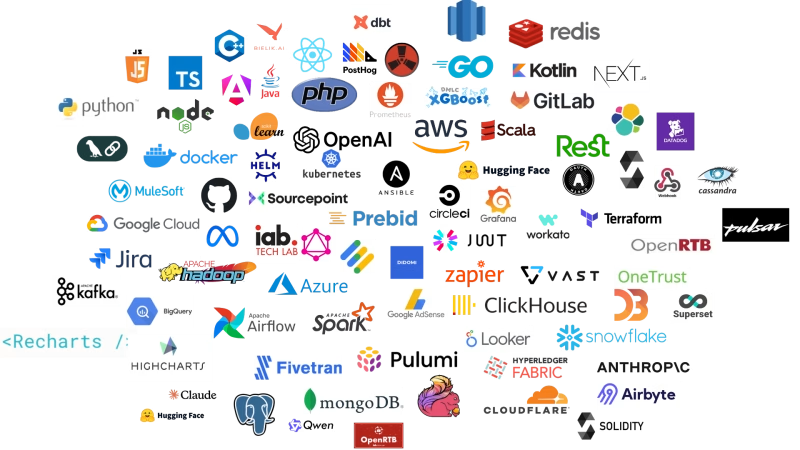
Most agency websites answer “what do you work with?” with a wall of logos. Ours did too. So here is the same wall, written out.

TL;DR: Data privacy compliance in AdTech and MarTech means mapping every data flow, building a real consent framework (not just a cookie banner), honoring deletion requests, embedding privacy-by-design into your stack, and vetting every vendor. Skip any of these and one weak link can trigger regulator fines under GDPR, CCPA/CPRA, VCDPA, or COPPA.
Privacy compliance laws aren’t a fire-breathing dragon but they will quietly bankrupt you if you treat compliance as a checkbox. This data privacy compliance checklist walks AdTech and MarTech teams through the 11 steps that actually protect your business, the most common compliance pitfalls, and the regulation-specific gotchas that trip up well-meaning companies. Whether you handle U.S. state laws, EU GDPR, or children’s data under COPPA, compliance is built on the same foundation: knowing your data, respecting user choice, and proving it.
Data privacy compliance is the ongoing practice of handling user data: collection, storage, sharing, and deletion, in line with applicable laws like GDPR, CCPA/CPRA, VCDPA, and COPPA. For AdTech and MarTech specifically, compliance means controlling how pixels, cookies, SDKs, CDPs, DMPs, ad servers, and CRMs collect and move personal data across web, app, email, and partner platforms. It’s not a one-time legal review – it’s an engineering and operational commitment.
The rules make more sense once you can picture the systems these rules are applied to.
Build your compliance program in 11 sequential steps: map data flows, build consent, operationalize deletion, maintain DPAs, embed privacy-by-design, audit regularly, train your team, vet vendors, deploy compliance tools, monitor legal changes, and adopt industry frameworks. Each step plugs a specific compliance gap that regulators look for.
Compliance gets cheaper when the data is yours to begin with, which is the argument behind building a data set you actually own.
You can’t protect what you can’t see. Document every data source, every processor, every controller, every sub-processor, and every destination. This is the foundation of every compliance audit and the first thing a regulator will ask for.
Compliance requires valid, documented consent. Implement tools that let users opt out of data sales and targeted ads, capture explicit opt-in for sensitive data where required, sync consent state across web, app, and partner platforms, and log every consent event in a data warehouse or audit system.
Give users a real deletion mechanism wired into every system – CDP, DMP, CRM, ad servers, backups, and logs. Respect the legal response windows. California (CCPA/CPRA) requires confirming the request within 10 days and responding within 45 days.
Keep your Data Processing Agreements and public privacy policy current, readable, and aligned with the rights users have in every state and country you operate in. Vague legalese is a compliance liability, not a shield.
Privacy-by-design is non-negotiable for AdTech compliance. Disable user tracking by default until explicit consent fires. Use consent-aware SDKs that check permissions before analytics or location tracking. Encrypt PII at rest and in transit. For AI/ML use cases, consider differential privacy or federated identity systems.
Schedule privacy compliance audits to catch issues before regulators do. Audits matter most when third-party vendors are in the stack – their gaps become your liability.
Everyone who touches user data needs basic compliance fluency. Training is one of the highest-ROI compliance investments because most violations come from internal misunderstandings, not malice.
Compliance is only as strong as your weakest sub-processor. Vet vendors for privacy compliance posture, real-time opt-out sync, and signed DPAs. Share data only with partners that honor user rights.
Compliance tooling cuts manual effort dramatically. Top options for AdTech and MarTech compliance:
| Tool | Best for |
| OneTrust | Consent management + privacy compliance policy automation |
| TrustArc | Data mapping and reporting |
| DataGrail | Consumer rights request handling |
| Securiti | End-to-end privacy automation |
| Vanta | Compliance monitoring + SOC 2 |
| Ketch | Consent and data control orchestration |
Privacy regulations change quarterly. Use the IAPP State Privacy Tracker, Clarip Tracker, and Termly State Law Map to monitor new compliance obligations.
If you operate in programmatic advertising, the IAB Multi-State Privacy Agreement (MSPA) standardizes your compliance approach across U.S. state laws and is increasingly expected by partners.
Retrofitting consent costs more than designing for consent from the first sprint, every time.
The most common AdTech and MarTech privacy compliance failures are: skipping privacy-by-design, weak consent practices, ignoring sensitive data categories, tool sprawl with unclear data handling, over-permissioned employee access, neglecting vendor compliance, and vague consent language. Each is fixable – but each is also a frequent regulator finding.
Most of these mistakes started as workarounds for what broke when third-party cookies went.
Each major privacy regulation has a signature compliance gotcha: GDPR penalizes wrong controller/processor classification and implied consent; CCPA/CPRA penalizes misunderstanding “sale”; VCDPA requires Data Protection Assessments; COPPA requires verifiable age checks before any data collection from children under 13.
| Regulation | Region | Most Common Compliance Mistake |
| GDPR | EU | Misclassifying role (calling yourself a processor when you’re a controller); accepting implied consent instead of clear affirmative action |
| CCPA/CPRA | California | Misunderstanding “sale” (it includes data sharing for value, including cross-context behavioral advertising); failing to separately handle Sensitive Personal Information |
| VCDPA | Virginia | Skipping mandatory Data Protection Assessments for targeted ads, profiling, or biometric processing |
| COPPA | U.S. (children under 13) | Letting users self-declare age; collecting persistent identifiers (not just names/emails) without verifiable parental consent; using third-party ads/analytics that capture children’s data |
Identity is where the regulations bite hardest, and there are two ways to prove who someone is with very different legal footprints.
Long-term compliance comes from habits, not heroics: keep a living data map, automate consent and DSR handling, monitor regulation trackers monthly, and treat compliance as engineering work, not a once-a-year legal review. Regulators look for good-faith effort and consistent process, not perfection.
You don’t need to memorize every privacy law. You need:
Remember: it’s not what you know about compliance – it’s what you didn’t know you were supposed to know that gets you fined. Clean data is also the precondition for everything in what AI adds once the data is clean.
GDPR is opt-in by default and applies to all EU residents; CCPA/CPRA is opt-out by default and applies to California residents. GDPR fines are larger (up to 4% of global revenue), but CCPA’s broad “sale” definition catches more AdTech activity than companies expect.
CCPA doesn’t require opt-in consent for cookies, but it requires a clear opt-out for any cookie that constitutes a “sale” of data which includes most third-party advertising cookies.
Under CCPA/CPRA, confirm the request within 10 days and respond within 45 days. Under GDPR, respond within one month. Most modern compliance tools automate this.
Map your data flows and audit which third-party scripts fire before consent. Those two actions surface 80% of common compliance gaps.
No. A CMP handles the consent capture layer, but compliance also requires data flow mapping, DPAs, vendor vetting, DSR fulfillment, and engineering-level privacy-by-design. A CMP is necessary but not sufficient.
If you would rather have someone else find the gaps, how we audit a codebase and report every finding by severity is on our audits page.
Most agency websites answer “what do you work with?” with a wall of logos. Ours did too. So here is the same wall, written out.

The hardest problems in AdTech and MarTech infrastructure are structural, not feature-level. Read why and how to solve it.

AI vs ML isn’t semantics. Machine learning is the AI subset that predicts outcomes from data: it runs bidding, targeting, and fraud detection.