Article partially generated by artificial intelligence.
TL;DR: The Quality Jobs Act is a planned EU law that the European Commission has announced for the end of 2026, and algorithmic management at work is one of its main topics. The rules that the Platform Work Directive sets for apps that allocate and rate gig work are expected to reach ordinary employers: HR systems, automatic shift scheduling and productivity monitoring.
Much of it is already required by the GDPR, the AI Act and national labour law, so employers and HR software vendors can start now with six changes: a decision inventory, explanations, human review, data exclusions, an off-hours cut-off and a worker information workflow. Sanddev, a software house in Wrocław, Poland, reviews and builds these parts of HR and workforce software.
Table of Contents
Key facts:
The Commission presented a Quality Jobs Roadmap in December 2025 and lists a Quality Jobs Act proposal for the end of 2026. Its second-stage consultation of social partners (July to September 2026) asked for views on algorithmic management and artificial intelligence at work. No proposal had been published by 19 November 2026.
Articles 7 to 11 of Directive (EU) 2024/2831 on platform work already ban emotion inference and data collection outside working time, require explanations and put a human behind account suspensions. They apply to platforms only, from 2 December 2026.
Since 2 February 2025 the AI Act has banned AI that infers emotions in the workplace, except for medical or safety reasons (Article 5(1)(f)).
What is the Quality Jobs Act and what will it change for employers?
The Quality Jobs Act is a legislative initiative of the European Commission that will update EU rules protecting workers. The Commission plans to propose it at the end of 2026. Algorithmic management and AI at work are among the consulted topics, so rules on transparency, human oversight and limits on workplace surveillance are likely to cover ordinary employers.
The official page states the goal in general terms: the new law “will update EU rules protecting workers while supporting productivity and competitiveness”. The first-stage consultation, from December 2025 to January 2026, covered the right to disconnect, algorithmic management and AI at work. The second stage, from July to September 2026, asked social partners for views on algorithmic management and artificial intelligence at work in more detail. The legal form, the scope and the date of application are still open, so everything below treats the act as planned, not as law.
What is not open is the direction. The EU already has a tested text for algorithmic management: Chapter III of the platform work directive. It was negotiated for gig work, but nothing in its logic depends on the worker being a courier. A warehouse picker whose pace is set by a scanner, a call centre agent ranked by handling time and a nurse whose rota is produced by an optimiser are all managed by systems that decide about their work. The Quality Jobs Act is the most likely vehicle for extending those rules to them.
Which workplace software counts as algorithmic management at work?
Algorithmic management at work means software that monitors workers or takes or supports decisions about them: hiring, task allocation, working time, pay, evaluation and dismissal. If a system ranks, schedules, scores or flags people, and a manager acts on its output, it belongs in scope, whether or not it uses machine learning.
The platform directive defines automated systems by what they decide, not by the technology. That is the safest reading for ordinary employers too. In practice the inventory usually covers four families of software:
System
Typical automated decision
Data that creates risk
HR system and applicant tracking
CV screening, candidate ranking, promotion and pay review suggestions
Inferred personality or emotion from video interviews, social media data, gaps in employment as a proxy for health or care duties
Automatic shift scheduling (rota software)
Who gets which shifts and hours, overtime offers, last-minute changes
Availability history, sick leave patterns, union activity, location outside working time
Productivity and activity monitoring
Idle time alerts, productivity scores, targets, warnings
Keystrokes, screenshots, webcam images, private messages, data collected after logout
Task allocation in warehouses, field service, call centres
Order of tasks, routes, pace, call routing
Scanner rates, GPS, handling times, sentiment scores from calls
Most of these systems are bought, not built, which splits the work. The employer is the controller under the GDPR and the deployer under the AI Act, so it carries the legal duties. The HR software vendor controls the design, so it decides whether the employer can meet them at all. A vendor that cannot export a decision log or turn off a field will lose tenders once buyers start asking for both.
Which employee monitoring laws already apply to workplace surveillance?
Three layers already apply. The GDPR covers every monitoring tool and every automated decision about employees. The AI Act bans emotion recognition at work and will regulate high-risk HR systems from 2 December 2027. National labour law, such as the Polish Labour Code, sets the procedure for monitoring. The Quality Jobs Act would add a fourth, employment-specific layer.
Under the GDPR, Article 22 limits decisions based solely on automated processing with legal or similarly significant effects, Article 35 makes an impact assessment mandatory for systematic monitoring, and Article 88 lets Member States set specific rules for employment, explicitly including monitoring systems at the workplace.
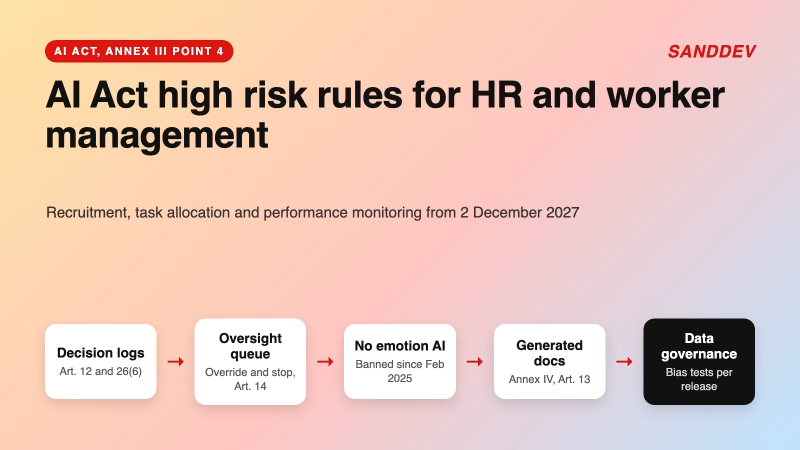
Under the AI Act, AI used for recruitment, task allocation based on behaviour or traits, and the monitoring and evaluation of workers is high-risk, and employers must inform workers’ representatives and the workers affected before they put such a system into use (Article 26(7)). We cover those obligations in detail in our guide to AI Act requirements for high-risk HR and recruitment systems.
Requirement
GDPR (now)
AI Act
Platform Work Directive
Quality Jobs Act (planned)
Ban on emotion inference
Only via proportionality and Art. 9
Banned at work since 2 Feb 2025 (Art. 5(1)(f))
Banned (Art. 7)
Likely, based on the consultation topics
No data collection outside working time
Data minimisation (Art. 5(1)(c))
Not specifically
Banned (Art. 7)
Likely
Explanation of decisions
Information on the logic (Arts. 13 to 15)
Right to explanation for high-risk systems (Art. 86), from 2 Dec 2027
Detailed duty (Arts. 9 and 11)
Likely
Human decides on serious sanctions
Limits on solely automated decisions (Art. 22)
Human oversight (Art. 14), from 2 Dec 2027
Mandatory for suspensions (Art. 10(5))
Under discussion
Informing workers’ representatives
Not specifically
Before use (Art. 26(7))
Information and consultation (Arts. 13 and 14)
Likely
The last column is our reading of the consultation documents, not a text. The point of the table is the overlap: four of the five rows are already required in some form, so building them now is not speculative.
Employee monitoring laws in Poland: what the Labour Code requires
In Poland, Article 22(2) of the Labour Code governs video monitoring and Article 22(3) governs email monitoring and “other forms of monitoring”, which in practice includes activity tracking and screen monitoring software. Both require a written purpose, scope and method, notice two weeks before launch and information before a person starts work.
Purpose test. Monitoring of email and other tools is allowed only if it is necessary to organise work so that working time is fully used and work tools are used properly (Article 22(3) § 1). Monitoring that serves curiosity or generic “engagement” analytics has no basis.
No private content. Email monitoring must not breach the secrecy of correspondence or other personal rights of the employee (Article 22(3) § 2). A tool that reads message content, takes screenshots of private chats or records webcam images goes beyond what most employers can justify.
Written rules. The purpose, scope and method must be set in the collective agreement, the work regulations or a notice (Article 22(2) § 6, applied through Article 22(3) § 3).
Timing. Employees must be told at least two weeks before monitoring starts, and each new employee must get the information on paper or electronically before starting work (Article 22(2) §§ 7 and 8).
Retention and places. Video recordings are kept for no more than three months unless they are evidence in proceedings, and monitoring does not cover rooms made available to the company trade union (Article 22(2) §§ 1(1) and 3).
The Polish data protection authority, UODO, reads these rules together with the GDPR: the Labour Code sets the procedure, but transparency, minimisation and the legitimate interest test still apply to every field the tool collects. For a vendor selling into Poland this means configurable purpose and retention settings per customer, an employee notice generated from the actual configuration and a hard switch that stops collection outside working hours.
What the Amazon warehouse case teaches about productivity monitoring
The case shows that regulators and courts judge each indicator separately. Real-time alerts tied to a clear operational purpose can survive. Keeping every indicator about every worker for a month “just in case” does not, and neither do weak information and access controls.
In its decision of 23 December 2025 (No. 492830), the Conseil d’État reviewed three scanner indicators that the CNIL had found unlawful: an alert when two items were scanned less than 1.25 seconds apart, an “idle time” alert after more than ten minutes of scanner inactivity, and a latency measure around breaks. The court held that processing them in real time did not breach Article 6(1)(f) of the GDPR. It upheld the breach of data minimisation for “the undifferentiated retention of all the indicators for 31 days”, along with uncontested breaches on information and on access to video surveillance software, and reduced the fine to EUR 15 million.
For product teams the lesson is concrete. Each metric needs its own purpose, its own retention period and its own access rule. A single “productivity data” table with one retention policy is the design that failed.
Quality Jobs Act readiness: 6 changes for HR software compliance
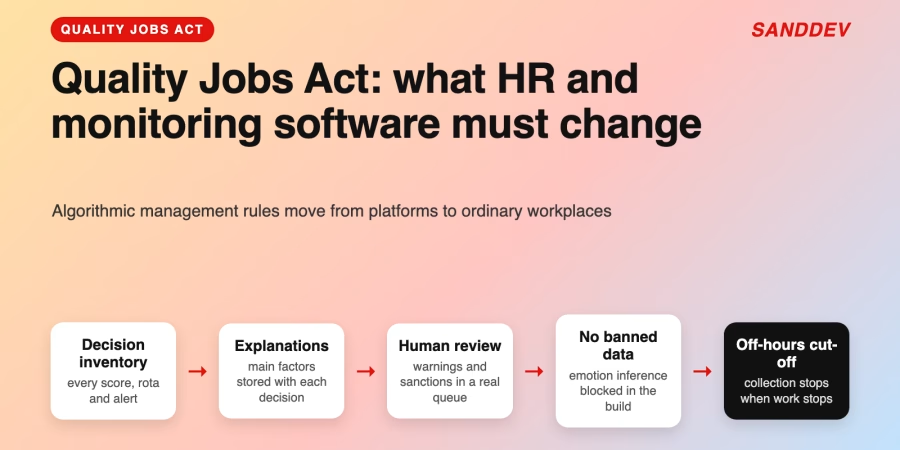
These six changes follow the platform directive’s Articles 7 to 11 and the existing GDPR and AI Act duties. Each one is a piece of software that can be tested, which is also how HR software compliance will be checked by customers, auditors and, later, inspectors.
1. An inventory of automated decisions
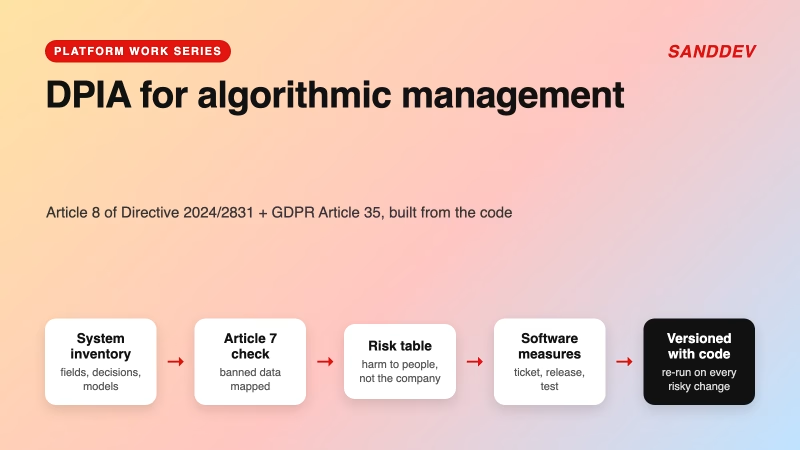
Start with a register, not a policy. For every decision the system takes or supports, record: the decision type (ranking, schedule, alert, score, sanction), the input fields, the rule or model version, who acts on the output and whether a human can override it. The same register feeds the impact assessment; our article on running a DPIA for algorithmic management systems shows how to turn it into one.
2. Explanations workers can read
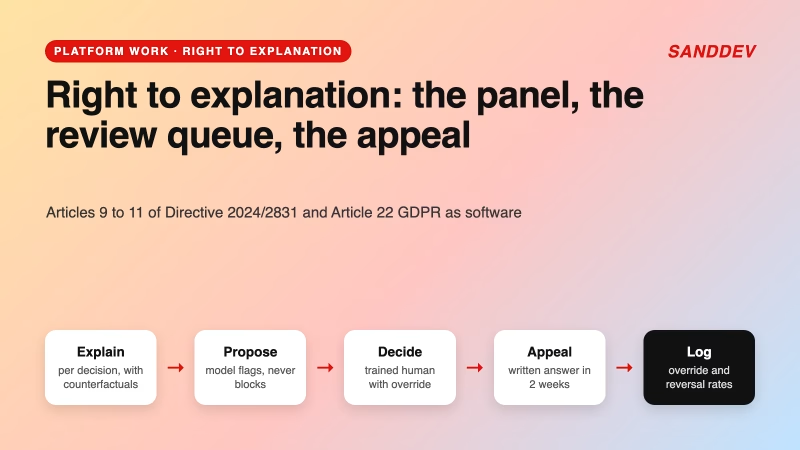
The platform directive requires the main parameters and their relative importance to be disclosed. For a rota engine that means telling an employee why they got the Saturday night shift: availability, seniority, a fairness rotation, a skills requirement. Store the top factors with each decision so the explanation is generated from the log, not reconstructed later.
3. Human review that is real
A warning, a pay deduction or a dismissal recommendation produced by a monitoring tool should land in a review queue with the evidence, the model output and a reject button that works. Log the reviewer, the time spent and whether they changed the outcome. A reviewer who confirms every proposal in a few seconds is a record against you.
4. Data exclusions enforced in code
Map every input field to the banned categories: emotional or psychological state, private conversations, inferred health, union membership or political views, and one-to-many biometric identification. Remove them from feature sets and add a test that fails the build if a banned field reaches a model or a scoring rule. Sentiment scores on call recordings and “mood” or “engagement” scores from webcams are the usual offenders, and in the workplace the emotion part is already banned by the AI Act.
5. An off-hours cut-off
Collection must stop when work stops. Tie agents, GPS and activity tracking to the working-time record, not to whether a laptop is on. Test it: log out, wait, and check that no events arrive. This also supports the right to disconnect, which the Commission consulted on in the same process.
6. Information and consultation workflow
Version the monitoring configuration and generate the employee notice from it. Any change in purpose, data or weights should trigger a notice to workers and their representatives before it goes live, with the two-week lead time required in Poland built into the release process. Keep an export so that representatives and authorities get the same picture the system uses.
Automatic shift scheduling: where rota algorithms create risk
Automatic shift scheduling creates risk when the optimiser uses data that predicts protected traits or punishes the exercise of rights. Availability penalties for sick leave, fewer hours after a complaint or worse shifts for people who decline overtime are decisions about people, even if the code calls them weights.
Scheduling engines are rarely seen as surveillance, but they are where algorithmic management is most visible to staff. Three checks catch most problems. First, list every feature in the objective function and ask what it is a proxy for; a “reliability” score built from absences is often a health proxy. Second, compare outcomes across groups: part-time staff, people returning from leave, union representatives. Third, record why each shift was assigned, so an employee who asks gets an answer drawn from the log. These checks are cheap to add during development and expensive to retrofit after a dispute.
Quality Jobs Act checklist for employers and HR software vendors
List every system that monitors employees or takes or supports decisions about them, including vendor tools and spreadsheets with formulas.
For each one, record the decision, the input fields, the model or rule version and who acts on the output.
Remove emotion inference and banned data categories, and add a build test that keeps them out.
Stop collection outside working time and prove it with an automated test.
Give each monitoring metric its own purpose, retention period and access rule.
Add explanations generated from the decision log and a review queue for warnings and sanctions.
Write down purpose, scope and method, inform staff and their representatives, and in Poland respect the two-week notice.
Run or update the DPIA and repeat it when the configuration changes.
How Sanddev reviews HR, scheduling and monitoring systems
We assess what the software does. Whether a given monitoring practice is lawful in your country is a question for your employment counsel, and the details will change once the Commission publishes its proposal.
FAQ
What is the Quality Jobs Act?
It is a planned EU law that the European Commission has announced for the end of 2026 to update rules protecting workers. Its consultations covered algorithmic management, AI at work and the right to disconnect. As of 19 November 2026 the proposal had not been published.
Will the Quality Jobs Act apply to ordinary employers or only to platforms?
The intention is to cover ordinary workplaces. Platforms already have their own rules in Directive (EU) 2024/2831. The new act is expected to bring similar rules on transparency, human oversight and monitoring limits to employers using HR, scheduling and monitoring software, but the final scope depends on the proposal.
Is employee monitoring software legal in the EU?
It can be, if it has a clear purpose, collects only what that purpose needs, is disclosed to staff and passes a balancing test under the GDPR. Emotion recognition at work is banned by the AI Act, and national labour law, such as the Polish Labour Code, adds procedural rules.
What do employee monitoring laws in Poland require?
Articles 22(2) and 22(3) of the Labour Code require a necessary purpose, written rules on purpose, scope and method, notice to staff at least two weeks before monitoring starts and information to each new employee before they start work. Monitoring must not breach the secrecy of correspondence.
Is automatic shift scheduling a high-risk AI system?
It can be. Under Annex III of the AI Act, AI that allocates tasks based on individual behaviour or personal traits, or monitors and evaluates workers, is high-risk, with obligations from 2 December 2027. A rules-based rota without AI is not covered by the AI Act, but the GDPR still applies.
Can an employer track employees outside working hours?
Generally no. Data minimisation under the GDPR already makes it hard to justify, the platform directive bans it for platform work, and the planned EU act is expected to address it for ordinary employers. Monitoring tools should stop collecting when the working-time record ends.
What should HR software vendors build first?
A decision log, a way to switch off banned data fields and an off-hours cut-off. These three support every other duty: explanations, human review, impact assessments and answers to workers’ representatives and authorities.