
- AdTech
- AI
- MarTech
- Software Engineering
Sanddev Best Tech Stack – Technologies We Built With
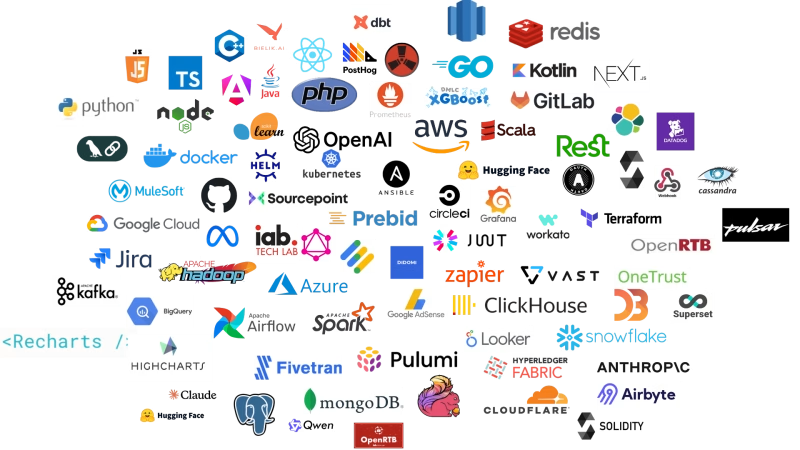
Most agency websites answer “what do you work with?” with a wall of logos. Ours did too. So here is the same wall, written out.

TL;DR: A first-party data strategy for AdTech is the system you use to collect, unify, and activate data you own: purchases, site behavior, and consented identity, so targeting, measurement, and personalization run on signals you control instead of cookies you rent. In 2026 it’s not a nice-to-have – it’s the infrastructure your ad stack runs on.
Owning the data does not exempt you from the paperwork. The compliance checklist behind all of this is a separate read.
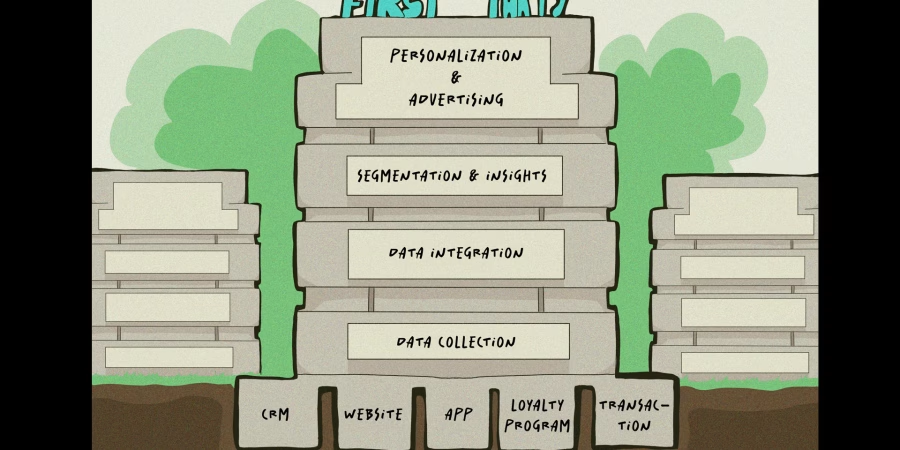
A first-party data strategy for AdTech is the playbook for turning data you collect directly into ad performance you can actually prove. It’s three moves: collect (purchases, clicks, form fills, consented IDs), unify (stitch it into one profile inside a CDP), and activate (push clean audiences into your bidding and measurement stack). Third-party data is rented. First-party data is owned, and in 2026, ownership is the whole game.
Because the rented signals advertisers leaned on for a decade are quietly vanishing. Privacy rules, browser restrictions, and iOS consent prompts have erased 30-40% of previously trackable conversions, and browser pixels alone now miss more than 30% of conversions. Marketers got the memo: 55.1% say first-party data is far more important than two years ago, and 91% of B2B marketers now collect it. A serious first-party data strategy is how you stop flying blind.
Decide what you want the data to do, then build backward from activation. Here’s the practical sequence:
Collection is one half; identity is the other, and how identity models differ in practice decides what you can actually join.
A lot: but only when marketing, not IT, actually owns it. A Google/BCG study found brands with mature programs see 2.9x higher revenue. Forrester clocked 83% better CAC, 73% better conversion, and 72% better ROI from first-party behavioral data. The plot twist? 52% of teams don’t own their data strategy and data that never gets activated pays out exactly nothing.
Treating it as a compliance checkbox instead of infrastructure. Data piles up in a shiny CDP, nobody activates it, and 40% of teams still can’t prove ROI with the answers sitting right there. The other usual suspects: no clear owner, browser-only tracking, and waiting for the “perfect” stack while competitors ship. A first-party data strategy only works if you own it, activate it, and measure it.
Infrastructure is the operative word customer data platforms and the attribution that has to come out of them is work we do by the quarter, not by the webinar.
Collecting it yourself is one answer to the identity problem; letting people carry their own credentials is the other, and it is further along than most teams assume.
First-party data activation is pushing your owned, consented data into ad platforms and DSPs so it actually drives targeting – not rots in a database.
Zero-party data is information customers hand you on purpose, like preferences, frequency choices, and quiz answers.
Third-party data is audience data bought from outside sources: the stuff cookies used to power.
A single customer view (SCV) is one unified profile merging every signal you hold on a customer – purchases, behavior, consent, identity – into one activatable record.
A lookalike audience is a prospecting segment modeled on your best existing customers, built from a first-party seed like your top-LTV buyers.
Data onboarding is uploading offline first-party data – CRM or loyalty lists – and matching it to online identifiers to reach those people across channels.
CAPI (Conversions API) is Meta’s server-side pipe for sending conversions straight to the platform.
Data enrichment is adding extra attributes: demographic, behavioral, firmographic, to your first-party records to sharpen segmentation and targeting.
UID2 and RampID are privacy-forward, consent-based identifiers built to replace the third-party cookie.
Signal loss is the ongoing erosion of trackable user data caused by privacy rules and browser limits.
Most agency websites answer “what do you work with?” with a wall of logos. Ours did too. So here is the same wall, written out.

The hardest problems in AdTech and MarTech infrastructure are structural, not feature-level. Read why and how to solve it.

AI vs ML isn’t semantics. Machine learning is the AI subset that predicts outcomes from data: it runs bidding, targeting, and fraud detection.