


- AI
Agentic Commerce Attribution: The Click Is Gone
Attribution has survived signal loss before. What makes agentic commerce attribution different is that the buyer never visited the site at all.

Agentic AI in advertising is not a smarter chatbot with a fancier vocabulary. It’s autonomous AI that plans, takes action, uses tools, loops back on results, and keeps going until the job is done. No prompt required. No hand-holding. No waiting for someone to log in on Monday and notice the campaign burned $40K over the weekend.
This is the honest breakdown: what agentic AI in advertising does in production, where it earns real ROI, and where it still spectacularly falls flat. Agents are one corner of a larger picture, and the wider map of AI in advertising puts them in context.
Regular AI generates. You give it a prompt, it gives you an output, it waits.
Agentic AI operates. It audits live campaigns, spots anomalies, reallocates budgets, drafts creative variants, briefs the design team, and sends you a summary, all before your second coffee. The goal drives the loop, not the prompt.
That’s why 79% of organizations report some level of agentic AI adoption, yet only ~11% actually run agents in production. The gap isn’t interest. It’s deployment reality. The difference matters more than the branding suggests, which is why we separated what counts as machine learning and what does not.
Everything in this post concerns agents that spend an advertiser’s money. The mirror image , agents that spend a consumer’s money and leave no click behind, is the measurement problem on the other side of the same market.
The most boring use case is the most valuable one. Agentic AI in advertising systems monitor spend pacing, CTR drops, creative fatigue, and tracking breakdowns in real time, flagging or fixing them without a human in the loop. No more waking up to a budget crater caused by a broken UTM.
An agent connected to your DSP can observe performance signals, compare them against pacing targets, and shift budget between campaigns or creatives based on guardrails agreed upfront. What your Thursday data already knew doesn’t have to wait until next Tuesday’s ops call.
Agentic AI in advertising doesn’t just spit out 12 ad headlines and vanish. A scoped agent can test creative concepts, identify winners, generate variants of those winners, and produce a brief with reasoning, ready for design or back into A/B rotation.
Important: Meta, TikTok, and Google have quietly started down-ranking obviously AI-generated creative in 2026. Agents that generate and quality-filter are beating agents that just generate.
The average marketing team visits 5+ platforms to understand one campaign. An agentic AI in advertising setup pulls from all of them, reconciles attribution conflicts, spots the last-click vs. data-driven discrepancy, and surfaces the insight, not raw data dumps.
Let’s be honest. The shiny demos skip the failure states.
For teams who deploy it properly:
| Metric | Result |
| Average ROI from agentic AI systems | 171% (US enterprises: 192%) |
| Cost savings in marketing operations | up to 37% |
| Time savings on complex multi-step tasks | 66.8% |
| Hours saved per marketer per week | 6.1 hrs avg, senior practitioners 8–10 hrs (HubSpot AI Trends 2026) |
For teams who wing it: 88% of AI agent initiatives fail to reach production (Digital Applied / IDC, March 2026 survey of 650 enterprise tech leaders), and Gartner puts the project cancellation risk at 40%+ by 2027. The difference is narrow scope, clean data, and a team that understands both ad tech and AI, not just one of them.
Point three is the one teams skip, so to be explicit about our own bias: we do not ship agents without a defined stopping condition.
The difference between AI and agentic AI in advertising is that regular AI responds to prompts. Agentic AI in advertising takes initiative: it plans, acts, uses tools, and loops back on results to reach a goal without constant human instruction.
For narrow, well-scoped workflows, agentic AI in advertising is production-ready in 2026. For autonomous control of your full media mix: not yet. Anyone saying otherwise is selling you a pilot.
The fastest ROI from agentic AI in advertising is campaign QA, budget pacing, anomaly alerts, and creative variant generation. High-volume, repetitive, measurable, exactly where agents outperform humans at scale.
Agentic AI in advertising works worse without first-party data. First-party data is the signal quality that drives agent decision-making. Clean data in → sharper actions out. Dirty data in → confident mistakes at scale.
Attribution has survived signal loss before. What makes agentic commerce attribution different is that the buyer never visited the site at all.
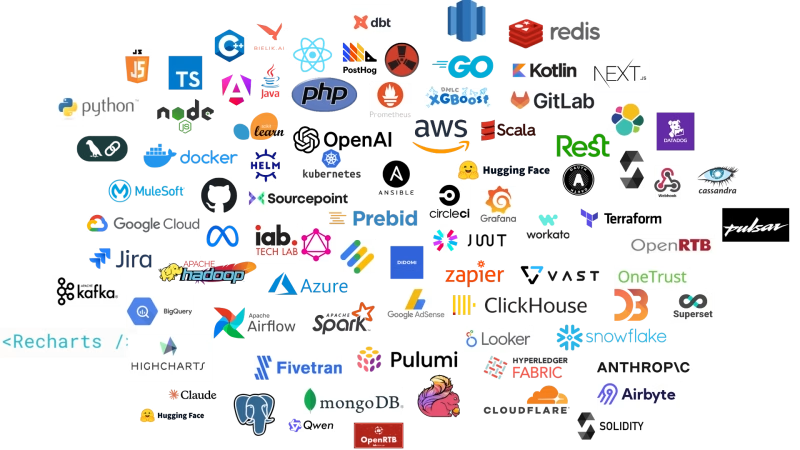
Most agency websites answer “what do you work with?” with a wall of logos. Ours did too. So here is the same wall, written out.

The hardest problems in AdTech and MarTech infrastructure are structural, not feature-level. Read why and how to solve it.