

- AdTech
- AI
- MarTech
- Software Engineering
Sanddev Best Tech Stack – Technologies We Built With
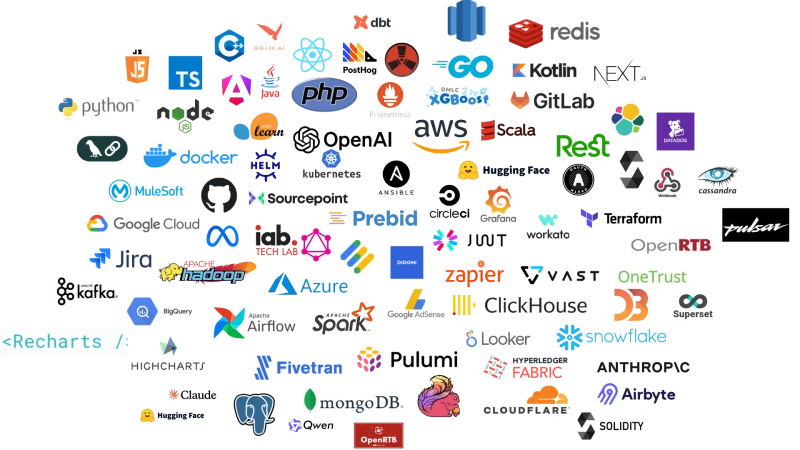
Most agency websites answer “what do you work with?” with a wall of logos. Ours did too. So here is the same wall, written out.

TL;DR: Privacy-first AdTech solutions are the new operating model, built on first-party data, decentralized identity, and consent-driven targeting instead of third-party cookies. Is no longer a “nice to have”. It’s the only sustainable way to target, measure and personalize advertising in a cookieless world while staying GDPR‑compliant and future‑proof.
This post is about the principle. The regulation-by-regulation detail sits in our compliance guide.
Privacy-first AdTech is the engineering and architectural approach that builds digital advertising systems around user consent, data minimization, and identity ownership, instead of bolting privacy on as a cookie banner afterthought. It treats privacy as a feature, not a tax. The core idea: users own their data, brands earn it through value exchange, and the entire AdTech stack is architected to deliver targeting, measurement, and personalization without leaking PII (Personally Identifiable Information, anything that can identify a specific person) across the open web.
Privacy-first AdTech isn’t a philosophy. It’s now a survival strategy. Third-party cookies are dying: slowly, messily, and on different timelines depending on which browser you’re talking about. Regulators are circling. Consumers are voting with their browsers. And the brands still trying to retrofit “privacy compliance” onto a 2018 stack are watching their CPMs implode.
In this guide about privacy-first AdTech we will break down where third-party cookies actually stand in 2026, how decentralized identity works, why first-party data became the operating system of modern advertising, and how privacy-first AdTech holds up under GDPR, CCPA, and the regulatory alphabet soup that’s still expanding.
Why now? Because the ground has shifted:
Privacy‑first AdTech isn’t a compliance tax. Done right, it’s your new competitive moat.
Third-party cookies are still technically alive in Chrome – but they’re effectively on life support, and Google’s “replacement” plan officially failed. Here’s the full timeline, because this space has been a regulatory rollercoaster and most online content is wildly outdated.
The original plan: Google announces in 2019 that Chrome will phase out third-party cookies. Apple’s Safari and Mozilla’s Firefox already block them by default, together representing roughly 30% of web traffic. The deprecation deadline gets pushed from 2022 to 2023 to 2024 to 2025.
July 22, 2024 Google officially abandons the plan to phase out third-party cookies. Instead, they’ll let users choose. Industry collectively rolls its eyes.
April 22, 2025 Google walks back even the user-choice prompt. Cookies stay on, no nag screen, business as usual in Chrome. Marketers who restructured their entire data stacks for the cookieless future feel deeply seen.
October 17, 2025 Change. Google formally retires most Privacy Sandbox APIs – Topics, Protected Audience, Attribution Reporting. Six years of work, billions of industry preparation dollars, retired. Only a small set of features survive: CHIPS (Cookies Having Independent Partitioned State), FedCM (Federated Credential Management), and Private State Tokens.
Where does that leave us in 2026?
So cookies aren’t dead, they’re zombies. Functioning, but unreliable, and subject to user revocation at any moment. Building your AdTech stack on third-party cookies in 2026 is like building a beach house on a tideline. The tide is coming in. The only debate is when.
The deprecation itself was the easy part; the measurement gap left behind is what teams are still patching.
Cookieless advertising is targeting, delivering, and measuring digital ads without relying on third-party tracking cookies, instead using first-party data, contextual signals, identity solutions, data clean rooms, and probabilistic models. It’s not one technology. It’s a whole new methodology that replaces “track everyone everywhere” with a stack of complementary techniques, each handling a piece of what cookies used to do single-handedly.
Here’s the modern post-cookie advertising toolkit:
The 2026 reality is that cookieless AdTech doesn’t replace cookies with one thing. It replaces them with a layered stack of complementary techniques, each contributing to a privacy-first AdTech whole.
Decentralized identity (DID) in privacy-first AdTech is a model where users control their own digital identity through cryptographic credentials stored in their wallet, instead of a centralized vendor database storing their PII. The user decides what to share, when, with whom, and for how long. AdTech platforms verify credentials cryptographically without ever holding the raw data themselves.
The mechanics:
For decentralized identity advertising, the implications are significant. You can run targeted, addressable advertising without ever holding raw PII. Identity becomes portable across platforms, interoperability that walled gardens fundamentally cannot offer. Fraud drops dramatically because every credential is cryptographically verified. And consent becomes auditable, which is increasingly a regulatory requirement, not a nice-to-have.
The challenges are real: wallet adoption is growing but uneven, account recovery is messy, partner interoperability requires standards alignment (W3C Verifiable Credentials and Decentralized Identifiers specs are leading), and most enterprises are still learning how to integrate DID into legacy stacks. According to industry reports, 2026 is the year DID adoption is expected to reach critical mass in enterprise applications: particularly supply chain, B2B transactions, and any sector where trust verification creates friction.
It solves real problems and creates new ones. We were blunt about where decentralised identity gets expensive.
A first-party data strategy is a brand’s plan to collect, govern, activate, and measure data that comes directly from its own customers, through owned channels, with explicit consent, and use it as the foundation for all advertising, personalization, and customer experience. In 2026, first-party data isn’t a tactic. It’s the operating system the entire advertising stack runs on.
GDPR (General Data Protection Regulation, the EU’s foundational data privacy law in effect since May 2018) shapes every architectural decision in modern privacy-first AdTech serving European users, from how data is collected, to how it’s stored, to how it’s shared, to how long it can be retained. GDPR-compliant advertising isn’t a checkbox. It’s a continuous discipline that touches every component of your stack, and the cost of getting it wrong is up to 4% of global annual revenue per violation.
The core GDPR principles that shape privacy-first AdTech architecture:
Lawful basis for processing. Every data processing activity needs a legal basis- usually consent for advertising, but sometimes legitimate interest. Consent must be freely given, specific, informed, unambiguous, and as easy to withdraw as to give. Pre-checked boxes don’t count. Bundled consent doesn’t count.
Purpose limitation. Data collected for one purpose can’t be used for another without new consent. Collected emails for newsletter signup? You can’t auto-pivot them into a retargeting audience. Each new purpose = new consent.
Data minimization. Collect only what you need. The maximalist “collect everything just in case” approach is a GDPR violation in itself.
Storage limitation. Don’t keep data longer than necessary. Privacy-first AdTech systems need defined retention policies – automated, auditable, enforceable.
Right to erasure (“right to be forgotten”). Users can request deletion. Your stack needs to actually be able to comply, across DSPs, CDPs, data warehouses, and partners.
Data subject rights. Access, rectification, portability, objection. Operationalizing these takes serious engineering investment.
Cross-border data transfers. Sending EU user data to non-adequacy countries (like the US, depending on which way the regulators are looking that year) requires Standard Contractual Clauses, supplementary measures, and ongoing transfer impact assessments.
Data Protection Impact Assessments (DPIAs). Required for high-risk processing — and “advertising at scale” usually qualifies.
The IAB Transparency and Consent Framework (TCF). The IAB’s standard for collecting and passing user consent through the AdTech supply chain. TCF v2.2 is the current version. Required for anyone running EU-targeted programmatic.
The intersection of GDPR and privacy-first AdTech is where most enterprise platforms reveal their architectural debt. If consent isn’t a first-class data structure in your system, if purposes aren’t enforceable at runtime, if deletion can’t be propagated across your partners – you have a compliance problem masquerading as a technical problem. Privacy-first AdTech bakes this in from day one.
Privacy-preserving advertising is the technical category of privacy-first AdTech techniques that deliver targeting, measurement, and personalization without exposing or aggregating raw user-level data, using cryptography, statistics, and architectural design to provide utility without compromising privacy. It’s the engineering side of privacy-first AdTech. Where “privacy-first” is a strategic stance, “privacy-preserving” is the math and code that makes it real.
The core techniques:
For privacy-preserving advertising to work at scale in production privacy-first AdTech, all of these techniques need to be wired into the auction logic, the targeting layer, the measurement stack, and the reporting pipeline. That’s a significant engineering lift – which is why most enterprise privacy-first AdTech projects building on foundations are essentially custom privacy-first AdTech development engagements, not off-the-shelf deployments.
Post-cookie advertising in 2026 looks like a layered stack, first-party data at the core, identity solutions and clean rooms in the middle, contextual and modeled signals at the edges, and AI orchestration tying it all together. There’s no single “cookies-but-better.” There’s a portfolio approach where each component handles part of what cookies used to do alone.
A practical post-cookie stack typically includes:
Identity layer
Targeting layer
Collaboration layer
Measurement layer
Compliance layer
The end result: a privacy-first AdTech stack that’s measurably more compliant, more durable to regulatory change, and (paradoxically) often more accurate than the third-party-cookie stack it replaces. First-party signals are higher quality than probabilistic ones, contextual targeting performs within 5-12% of behavioral targeting, and clean rooms unlock collaborative measurement that cookies could never enable.
Walled gardens (eg. Google, Meta, Amazon, closed advertising ecosystems with their own login-based identity) are benefiting because they already operate on first-party data, with consented identity, and don’t need third-party cookies to function. Every regulatory tightening of the open web pushes more advertisers spend into their environments. According to industry analysis, Google, Meta, and Amazon collectively account for 54.7% of the global digital advertising market (excluding China), expected to rise to 56.2% in 2026.
The walled garden advantage:
The risk for advertisers: deeper dependence on platforms that already control more of the market each year, with less transparency, less control, and rising fees. This is exactly why custom privacy-first AdTech development for retail media networks, brand-direct measurement, and open-web targeting is having such a moment in 2026, it’s the only path that builds long-term advertiser leverage outside the walled gardens.
Building a privacy-first AdTech platform requires architectural decisions you can’t easily reverse, consent has to be a first-class data type, purposes have to be enforceable at runtime, and data minimization has to be baked into every pipeline. It’s not “regular AdTech with extra steps.” It’s a fundamentally different design philosophy. Trying to retrofit privacy onto a pre-2024 stack is how teams end up with 18-month rewrites.
The architectural fundamentals of privacy-first AdTech platform:
Consent as a first-class data type. Every event, every audience, every record carries its consent context: purpose, scope, expiration, jurisdiction. Your data model includes consent objects, not consent flags.
Purpose bound data flows. Data collected for advertising can’t be used for analytics. Data collected for analytics can’t be used for personalization. Each pipeline enforces purpose at the schema level.
Privacy by design. GDPR Article 25. Build privacy into every architecture decision from the start: data minimization, encryption at rest and in transit, pseudonymization wherever possible, audit logging by default.
Server-side first. Client-side tracking is unreliable in 2026: 30-50% of conversions get lost to ad blockers, browser restrictions, and consent gates. Server-side tracking with secure server-to-server APIs is the new default.
Identity abstraction. Don’t hardcode to third-party cookies, or any single identifier. Build an identity resolution layer that accepts first-party IDs, universal IDs, hashed emails, and decentralized credentials, and routes them through with appropriate consent handling.
Data lineage and audit. Every record knows where it came from, when it was collected, under what consent, who’s accessed it, and when it expires. This is increasingly required by regulators and demanded by enterprise buyers.
Deletion-ready architecture. When a user requests erasure, the system must propagate that request across every storage layer, including partner systems where data was syndicated. This is one of the hardest engineering problems in modern AdTech.
Real-time consent enforcement. Targeting decisions, suppression lists, frequency caps, all must check current consent status, not last week’s snapshot.
Open standards integration. IAB TCF, GPP, OpenRTB consent extensions, W3C Verifiable Credentials. Privacy-first AdTech can’t be a snowflake, it needs to interoperate.
Most enterprise teams hit a wall when they realize their existing AdTech can’t be patched into compliance. The retrofit cost ends up higher than building privacy-first from scratch, which is why most of our recent privacy-first AdTech engagements at Sanddev have started with this exact problem.
Privacy regulation isn’t just GDPR anymore, there’s a growing global patchwork of laws, each with its own scope, enforcement model, and implementation requirements. Privacy-first AdTech systems serving global audiences in 2026 have to handle dozens of overlapping regimes, often with conflicting requirements. The compliance burden is real, but it’s also a competitive moat for the brands and platforms that handle it well.
The major regimes:
Cross-jurisdictional privacy-first AdTech operations now require:
The platforms that win in 2026 aren’t trying to comply with one regulation. They’re architecting for regulatory portability, building systems where adding a new jurisdiction is a configuration change, not a re-engineering project.
Sanddev builds privacy-first AdTech platforms end-to-end: from first-party data infrastructure to consent management to clean room integrations to custom DSPs and SSPs designed around decentralized identity. The part that decides whether any of it survives year two is domain modelling, so consent sits in the data structure rather than on top of it.
We’ve spent the last decade engineering for ad platforms where compliance, performance, and revenue all have to coexist. We don’t bolt privacy onto legacy stacks. We architect from privacy outward.
Our methodology: we take responsibility for the project, result, scope and on-time delivery. Amen.
What we typically work on:
We combine PRINCE2 project governance with Agile delivery. Our engineering team is senior-only. No paid internships on your project.
If you’re scoping a privacy-first AdTech build: a first-party data platform, a custom DSP/SSP with consent baked in, a retail media network, or a migration from a legacy stack, we’d love to talk. Twenty minutes of honest scoping beats a 30-page proposal every time.
Privacy-first AdTech is the architectural and strategic approach that builds digital advertising systems around user consent, data minimization, and identity ownership instead of third-party cookies and cross-site tracking.
No, third-party cookies still work in Chrome (approx. 67% of global browser share) but are blocked by default in Safari and Firefox (approx.30% of traffic). Google abandoned its plan to deprecate them in July 2024 and formally retired most Privacy Sandbox APIs in October 2025.
Decentralized identity is a model where users control their own digital identity through cryptographic credentials stored in their wallet, instead of a centralized vendor database. The user decides what attributes to share, with whom, and for how long.
Decentralized identity advertising uses DID infrastructure to deliver targeted ads without ever holding raw PII. Brands verify user attributes cryptographically through user-controlled wallets, with consent that’s auditable and revocable.
Cookieless advertising is digital ad targeting, delivery, and measurement that doesn’t depend on third-party cookies, instead using first-party data, contextual signals, universal IDs, decentralized identity, data clean rooms, and probabilistic models.
Post-cookie advertising is the broader strategic shift away from cookie-dependent AdTech toward first-party-data-centric, consent-driven, identity-portable models. It’s the “after” state of cookieless advertising.
First-party data is information a brand collects directly from its customers through owned channels (website, app, CRM, loyalty program), with explicit consent. It’s the most accurate, durable, and compliant data type in 2026.
A first-party data strategy is a brand’s plan to systematically collect, govern, activate, and measure first-party data, typically including identification systems, consent management, CDPs, activation pipelines, server-side tracking, and clean room collaboration.
First-party data AdTech refers to advertising platforms and tools designed to operate on first-party data as the primary signal, including CDPs, first-party-data-driven DSPs, retail media networks, and identity resolution platforms.
Ad fraud is when bad actors use bots, fake clicks, or hidden ads to trick advertisers into paying for traffic or impressions that aren’t real. It drains ad budgets, skews performance data, and can cost the industry tens of billions of dollars every year.
A CDP (Customer Data Platform) is software that unifies first-party customer data across systems (web, app, CRM, point of sale) into a single profile, then activates that profile across marketing and advertising channels.
GDPR-compliant advertising is digital advertising that meets the EU’s General Data Protection Regulation requirements – including lawful basis for processing, explicit consent, purpose limitation, data minimization, storage limits, and operational support for data subject rights.
Server-side tracking is the practice of collecting marketing events on your own server (instead of in the user’s browser), then forwarding them to advertising platforms via secure server-to-server APIs. Recovers 15-30% of conversion data lost to client-side restrictions.
The right to be forgotten (right to erasure under GDPR Article 17) is a user’s right to request deletion of their personal data. AdTech platforms must be able to propagate deletion requests across all storage layers and partners.
Most agency websites answer “what do you work with?” with a wall of logos. Ours did too. So here is the same wall, written out.

The hardest problems in AdTech and MarTech infrastructure are structural, not feature-level. Read why and how to solve it.

AI vs ML isn’t semantics. Machine learning is the AI subset that predicts outcomes from data: it runs bidding, targeting, and fraud detection.