

- AdTech
- AI
- MarTech
- Software Engineering
Sanddev best tech stack – technologies we built with
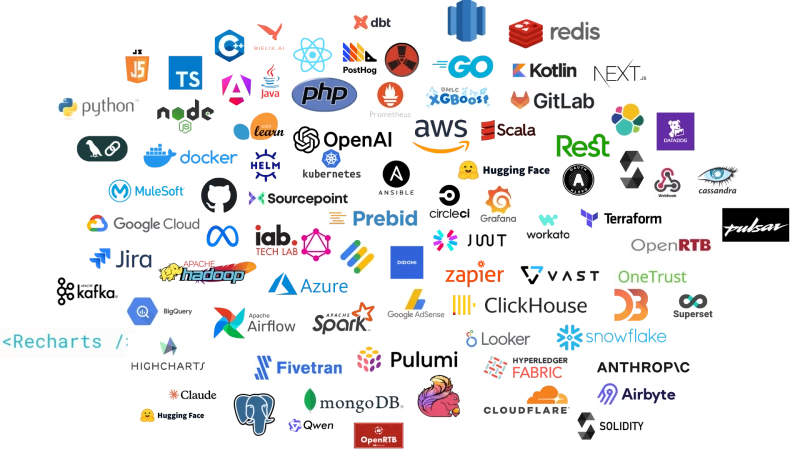
Most agency websites answer “what do you work with?” with a wall of logos. Ours did too. So here is the same wall, written out.

TL;DR: AdTech project management is the discipline of planning, controlling and delivering complex advertising-technology projects like DSPs, SSPs, CDPs, ad servers, attribution stacks, without setting fire to your roadmap. The hard part isn’t the tech. It’s the migrations: 83% of data migration projects fail or blow budgets. A blended PRINCE2 + Agile delivery methodology is how the surviving 17% get there.
If your AdTech migration plan fits on a sticky note and your “go-live” date keeps quietly sliding into next quarter, congratulations: you’re a perfectly average AdTech project. Welcome. The coffee is bad and the timelines are worse.
Let’s fix that.
AdTech project management is the practice of planning, executing and governing technology projects across the advertising ecosystem (DSPs, SSPs, ad exchanges, ad servers, DMPs, CDPs, attribution platforms and identity tooling) under brutal constraints: real-time data volumes, fragmented vendors, privacy regulation, and stakeholders who all define “done” differently.
See more about Adtech software development.
It’s project management on hard mode. You’re not shipping a SaaS dashboard. You’re orchestrating systems that touch 200 billion+ daily programmatic auctions, billions of events, and a regulatory landscape that shifts every quarter.
The job covers:
Do it well and revenue scales. Do it badly and you’re explaining a six-figure overrun to a CFO who didn’t enjoy the previous one either.
AdTech migration is harder because AdTech is a real-time, multi-vendor, low-latency ecosystem where every component depends on every other component and one broken tag can silently nuke a quarter of your revenue. Regular SaaS migrations break dashboards; AdTech migrations break money.
Three reasons it gets ugly fast:
This is why software migration AdTech projects fail at brutal rates. According to Gartner, 83% of data migration projects either fail outright, exceed budgets, or take longer than planned. The Bloor Group reports cost overruns average 30% and time overruns average 41%. A Cloud Security Alliance report found 90% of CIOs have experienced failed or disrupted data migration projects. That’s not a tech problem. That’s a AdTech project management problem.
Read here about 10 the most notorious and painful migrations.
AdTech projects fail because of underplanning, scope creep, data quality shocks, and weak governance – almost never because the technology was impossible. Failure follows a depressingly predictable pattern.
The repeat offenders, with receipts:
This is exactly where a real AdTech delivery methodology earns its keep. Fancy to know more? See 5 models of failure platform migration and how to handle it.
The best AdTech delivery methodology is a hybrid – PRINCE2 for governance and stage control, Agile for execution inside each stage. Pure Agile loses to AdTech complexity; pure waterfall loses to AdTech speed. The blend wins.
Here’s why this stack works for AdTech specifically:
PRINCE2 AdTech governance gives you:
Research confirms PRINCE2 remains a highly valued methodology in the IT industry, especially in projects with a high degree of complexity and risk – which is the actual job description of every AdTech program. IDEAS/RePEc
Read here how you can transform project chaos into a masterclass with PRINCE2.
Agile inside the stages gives you:
The hybrid model means leadership gets the PRINCE2 dashboard they need to sleep at night, and the delivery team gets the agile cadence they need to actually ship. Everyone wins. Nobody resigns.
A winning AdTech project management framework runs in five stages – Discovery, Design, Build, Migrate, Optimize – each with its own gate, deliverables and explicit data quality checkpoints. No stage gets skipped. No deliverable gets hand-waved.
| Stage | What happens | Gate criteria |
| Discovery | Audit current stack, vendors, data flows, consent posture, hidden dependencies | Signed business case, risk register, success metrics |
| Design | Target architecture, vendor selection, data model, integration map | Approved blueprint, RACI matrix, compliance sign-off |
| Build | Sprint-based development, API integrations, test environments | Test coverage ≥30% project time, parallel-run plan |
| Migrate | Phased cutover, dual-running, monitoring, rollback plan ready | Reconciliation reports, revenue parity check |
| Optimize | Performance tuning, decommissioning legacy, knowledge transfer | Documented handover, post-mortem, KPI baselines |
Two non-negotiable rules:
Read about best practices for upgrading without the headaches.
You measure AdTech project management success on four dimensions: delivery (on time, on budget, in scope), data quality (parity between old and new systems), operational continuity (zero revenue gaps), and adoption (the new stack actually gets used). Pick KPIs in each. Don’t fudge them.
Hard metrics worth tracking:
If you’re not measuring these, your “successful” migration is just a migration that hasn’t been audited yet.
A realistic AdTech migration takes 4–9 months for mid-complexity stacks (single DSP/SSP swap, ad server change, GA4 transition) and 12–18+ months for enterprise programs (full stack replatform, multi-region, CDP rollout). Anyone quoting six weeks is selling something.
The honest timeline drivers:
Build slack into the plan. Then build more slack. You will need it.
PS. If you want to see the proper project management, see our case study how we increased our client’s sales velocity from 757%.
PRojects IN Controlled Environments, version 2. A process-based project management methodology used in over 150 countries, especially strong for complex, high-risk IT delivery.
Mobile Measurement Partner. Third-party attribution for mobile app installs and in-app events.
Operating old and new systems simultaneously during cutover, so you can reconcile outputs and roll back if needed.
The slow expansion of project scope without matching time/budget — affects 72% of failing migration projects.
A formal checkpoint in PRINCE2 where the Project Board decides to continue, adjust or stop the project.
Comparing source and target system outputs (records, revenue, conversions) to confirm migration accuracy.
Most agency websites answer “what do you work with?” with a wall of logos. Ours did too. So here is the same wall, written out.

How we work: we don’t. We engineer wins. Every company has its own way of “how we work” – some do it like a symphony, others like a rock band with no drummer. At Sanddev, we don’t just handle code – we treat it like royalty. With proper code management, clear standards, and continuous integration […]

The hardest problems in AdTech and MarTech infrastructure are structural, not feature-level. Read why and how to solve it.