
- AdTech
- AI
- MarTech
- Software Engineering
Sanddev Best Tech Stack – Technologies We Built With
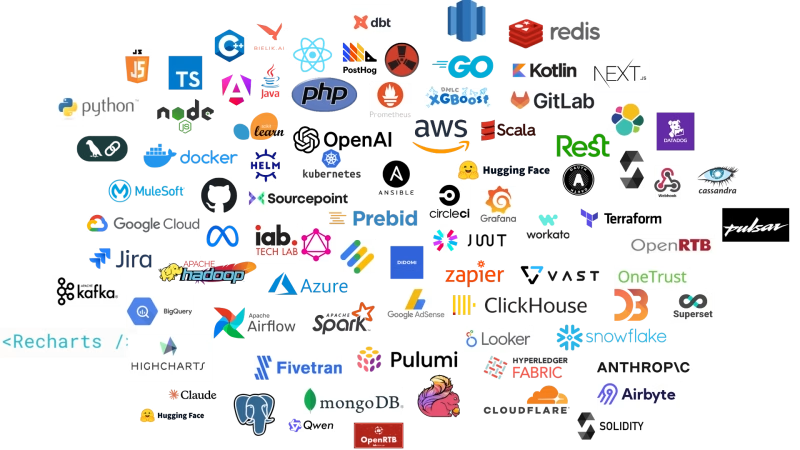
Most agency websites answer “what do you work with?” with a wall of logos. Ours did too. So here is the same wall, written out.

Scrolling through LinkedIn (as one does when avoiding real work) I stumbled across the story of The Trade Desk’s migration disaster. Turns out painful migrations in AdTech are less of a rare exception and more of a rite of passage. And no, size doesn’t protect you. Google and Microsoft both have the scars to prove it. Every entry here traces back to one early decision, which is why the build-or-replace call matters this much.
Let’s see our subjective list (random order) of most notorious and painful platform migrations.
Chapter 1: Sizmek was a major independent ad server competing with DoubleClick. Between 2014–2017 it acquired Peer39 (brand safety), PointRoll (rich media), RocketFuel (AI-driven DSP), and others. Each ran on its own codebase. The attempt to consolidate these into a single platform consumed massive engineering resources. Technical debt piled up, the platform became unreliable, and clients left. The consequence of this painful migrations was that in March 2019 they filed Chapter 11.
Chapter 2: Amazon bought Sizmek’s ad server and related tech, inheriting two separate ad server platforms: a legacy one (kept for big, complex clients) and a newer platform. For years they were effectively running two ad servers in parallel at high cost while trying to move customers to the newer stack. Many large clients resisted because the new system lacked advanced attribution features they relied on. In 2023-2024, Amazon rebranded to Amazon Ads Server and then decided to sunset the ad server entirely by end of 2024, forcing clients to migrate again to other ad servers (Google, Flashtalking, Adform, etc.)
Where it hurt:
Google long ago fused its publisher ad server (DFP) with AdX into what is now Google Ad Manager (GAM). This tight bundling and migration path is at the center of the DOJ antitrust case, with courts finding that it effectively locked publishers into Google’s stack. On top of the original migration, Google keeps changing how access and controls work:
Where it hurt
For publishers outside the Google mothership, every structural change in this painful migrations has meant:
In 2013, AppNexus (now Xandr) rolled out a data update from an internal database to the “impression bus” cluster – the core component that receives ad requests and runs auctions. The update passed validation but triggered a crash of around 900 servers worldwide at almost exactly the same time, fully halting ad serving, then partially degrading it, for about 2.5 hours.
Where it hurt
AT&T paid approximately $1.6B for AppNexus in 2018, rebranding it Xandr. The plan was to fuse AppNexus’s programmatic capabilities with AT&T’s first-party subscriber data and WarnerMedia content. In practice, it was painful migrations: AT&T’s telecom IT infrastructure and AppNexus’s AdTech stack were worlds apart. Privacy constraints on AT&T subscriber data limited the original vision significantly. After AT&T spun off WarnerMedia, Xandr lost its strategic rationale. Microsoft acquired it in 2022 for roughly $1B – a significant loss on AT&T’s original investment – primarily to integrate with Netflix and other CTV supply.
What went wrong:
Microsoft bought aQuantive (including the Atlas ad server) for $6.3B in 2007, then wrote most of it off. Facebook then bought Atlas from Microsoft in 2013 for a relatively small amount (~$30–100M) and tried to rebuild it into a Google DoubleClick competitor. Facebook also bought LiveRail, a video ad platform, to expand its external Adtech footprint. It was another painful migrations – both products struggled to gain adoption, with:
Facebook eventually shut down the ad serving side of Atlas and parts of LiveRail around 2016-2018, pivoting focus back to its own walled garden products.
Where it hurt:
Verizon acquired AOL ($4.4B, 2015) and Yahoo ($4.5B, 2017) with ambitions to build a third adtech giant to rival Google and Facebook. The attempt to merge fundamentally incompatible ad stacks – ONE by AOL, Yahoo Gemini, BrightRoll DSP, Yahoo’s DMP – into a unified “Oath” platform was not just painful migrations lub catastrophic. Each system had different data models, bidding logic, and identity graphs. In practice, buyers and ops people described it as a “Frankenstein” platform:
Engineers spent years trying to reconcile them. In 2018, Verizon took a $4.6B goodwill write-down. They eventually sold the whole thing to Apollo Global for $5B in 2021 – after spending roughly $9B buying it.
Where it hurt:
MediaMath was one of the original DSPs, founded in 2007. For years they ran on aging infrastructure, and around 2019–2021 they attempted a complete platform rewrite called “Origin” -intended to be a transparent, clean-room, supply-path-optimized next-gen DSP. The rewrite was perpetually delayed. They burned through capital, couldn’t close a restructuring deal, and filed Chapter 11 in June 2023. Hundreds of publishers were left owed money. This is an example of painful migrations where the bankruptcy was sudden enough that campaigns went dark mid-flight for many advertisers.
What went wrong:
Oracle spent over $2B across a decade acquiring AdTech assets – BlueKai (DMP, ~$400M, 2014), Datalogix (offline data), Crosswise (cross-device), AddThis (audience data), Moat (measurement), Grapeshot (contextual). The ambition was a full marketing and advertising data cloud. The technical challenge of integrating fundamentally different data architectures, identity systems, and customer bases proved too great. Painful migrations? Yeap, none of the products fully unified. Moat lost clients steadily to IAS and DoubleVerify. Oracle announced it was shutting down its entire advertising business in 2024.
What went wrong:
Nielsen attempted to transition from its legacy TV panel measurement to “Nielsen One,” a cross-platform currency that could measure audiences across linear TV, streaming, digital, and social simultaneously. The (painful) migrations was delayed repeatedly (announced ~2019, still incomplete by 2024). In 2021 the Media Rating Committee suspended Nielsen’s accreditation after discovering it had been undercounting TV viewers during COVID – largely because the pandemic disrupted their panel recruitment and the migration to new methodologies was incomplete. Broadcasters used this as a trigger to accelerate alternatives (VideoAmp, Comscore, iSpot.tv). Nielsen lost hundreds of millions in revenue.
What went wrong:
TTD’s old platform (Solimar) worked. Users loved it. It was intuitive, stable, and battle-tested. Then they built Kokai – an AI-powered successor that required a fundamental UX overhaul. The migration has been painful:
What went wrong:
I’ve asked myself why in AdTech painful migrations (or replatforming) is so common. The answer is quite simple: AdTech industry runs on infrastructure which never sleeps. You can’t close it at 3cam like ecommerce or finance services.There is no tolerance for downtime. Campaigns don’t pause while your engineers wrestle with a broken data pipeline. And the dependencies- DSPs talking to SSPs, DMPs syncing with CRMs, measurement layers stitched on top of everything – mean that pulling one thread can unravel the whole fabric.
Moreover beneath every programmatic bid, every targeting segment, every real-time auction sits a stack of platforms, pipes, and integrations that took years- sometimes decades- to build. So when a company decides to move, to replatform, to “modernize,” the stakes are existential.
Across all of these, a few patterns repeat consistently in painful migrations: underestimating the complexity of merging identity graphs and data models from different sources; the “big rewrite” trap where companies try to replace working systems entirely rather than incrementally; adtech-specific speed requirements (sub-100ms auctions) that make poorly integrated systems fail in production in ways that wouldn’t matter in other software; and cultural mismatches when large corporations (Verizon, AT&T, Oracle) acquire fast-moving adtech companies and impose enterprise processes on them.
The survivors had governance. That is the argument for putting a board between you and the chaos.
Let’s deconstruct these painful migrations models and architect the recovery. In practice that starts with the architecture reconstructed from the source, so you know what you actually own.
Most agency websites answer “what do you work with?” with a wall of logos. Ours did too. So here is the same wall, written out.

The hardest problems in AdTech and MarTech infrastructure are structural, not feature-level. Read why and how to solve it.

AI vs ML isn’t semantics. Machine learning is the AI subset that predicts outcomes from data: it runs bidding, targeting, and fraud detection.