Article partially generated by artificial intelligence.
TL;DR: The Cyber Resilience Act (CRA) has required, since 11 September 2026, manufacturers of products with digital elements to report actively exploited vulnerabilities and severe incidents. An early warning is due within 24 hours of becoming aware, a full notification within 72 hours and a final report later. Reports go through the ENISA single reporting platform to the national CSIRT. The duty also covers products already on the market. This article explains what must be reported, the deadlines, and how to build a process that can meet a 24-hour clock.
The duty also covers products placed on the market before the CRA applies in full on 11 December 2027.
Breaching the reporting obligations can cost up to €15 million or 2.5% of worldwide turnover.
Who must report under the Cyber Resilience Act?
The Cyber Resilience Act places the reporting duty on the manufacturer of a product with digital elements: the company that designs or makes a product and places it on the EU market under its own name. A product with digital elements can be hardware with software inside (a controller, a meter, a camera, an EV charger, a machine with a control panel) or standalone software sold to customers. Open-source software stewards have obligations too, to the extent they support components used commercially.
The CRA excludes products with their own cybersecurity rules, such as medical devices and motor vehicles. SaaS is generally out of scope, unless remote data processing is essential to a product’s function, for example a cloud service without which a smart home device does not work.
What must be reported under the CRA?
The Cyber Resilience Act defines two kinds of report. The first covers an actively exploited vulnerability: a flaw for which there is reliable evidence that someone has exploited it in a system without the owner’s permission. Knowing about a vulnerability, even a critical one, does not trigger the duty; evidence that it is being used in attacks does.
The second covers a severe incident affecting the security of the product. That means an event that undermines the product’s ability to protect the availability, authenticity, integrity or confidentiality of data or functions, or that led to malicious code running in the product or in users’ systems. One example: an attacker takes over the update server and pushes modified firmware.
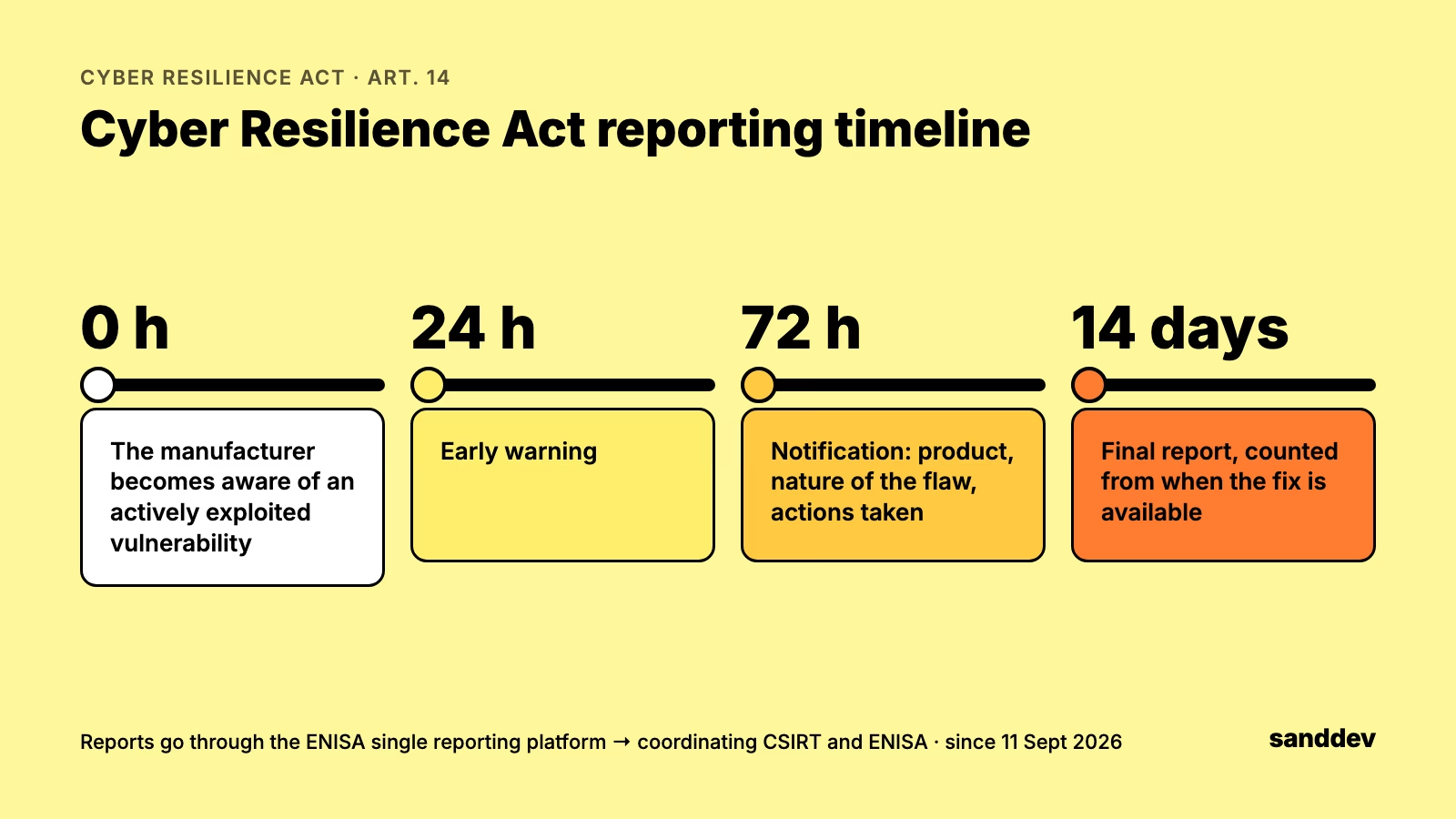
Cyber Resilience Act requirements: the 24-hour, 72-hour and 14-day deadlines
Stage
Actively exploited vulnerability
Severe incident
Early warning
within 24 hours of becoming aware
within 24 hours of becoming aware
Notification
within 72 hours: product details, nature of the vulnerability, measures taken
within 72 hours: nature of the incident, initial assessment, corrective measures
Final report
no later than 14 days after a fix or mitigation is available
within one month of the notification
A single report goes at the same time to the CSIRT acting as coordinator in the manufacturer’s main Member State and to ENISA. According to ENISA’s FAQ on the reporting platform, the platform is meant to simplify reporting, especially for products sold in several countries. Manufacturers must also inform affected users about the vulnerability or incident and how to reduce the risk.
Why 24 hours is a process problem, not a legal one
The 24-hour clock starts when the manufacturer becomes aware of an exploited vulnerability, not when legal finishes its analysis. In practice, a company needs four things in place before anything happens:
An intake channel, such as a security@ address and a published vulnerability disclosure policy.
An on-call owner who can decide within hours whether a report affects the product and whether there is evidence of exploitation.
Knowledge of what the product is made of. Without an SBOM, it is hard to tell quickly whether a flaw in a popular library affects firmware sold three years ago.
A ready report template and tested access to the ENISA platform.
The third point is the most common gap among device makers. We cover how to prepare an SBOM in a separate guide.
CRA compliance: a plan for the coming weeks
List the products with digital elements you sell or support, with the software versions in circulation.
Name a process owner and a deputy, and agree who decides to report.
Publish a vulnerability disclosure policy and open an intake channel.
Produce an SBOM at least for current product versions and monitor vulnerability databases.
Register on the ENISA platform and rehearse a report with a fictional scenario.
Plan how fixes reach customers: remote updates, service instructions, customer notices.
Cyber Resilience Act and NIS2: do you report twice?
A manufacturer that is also an essential or important entity under NIS2 can face two separate reporting duties. The Cyber Resilience Act concerns the security of the product the manufacturer sells: a flaw in a controller’s firmware or an incident that hit customers’ devices. NIS2 and the national laws that implement it, such as Poland’s KSC Act, concern incidents in the company’s own systems, for example an attack on its network, production systems or email, reported to the national CSIRT through the national channel.
One event can trigger both. If an attacker breaks into the manufacturer’s network, takes over the update server and pushes modified software to customers, that is both an incident in the company’s systems under NIS2 and a severe incident affecting product security under the CRA. Deadlines are similar, but forms, recipients and the information required differ. That is why an incident procedure needs two paths and a clear rule on who decides which one to trigger, and when to trigger both.
The first 72 hours in practice
Take a maker of heating controllers with a Wi-Fi module. On Monday at 9:00, a security researcher writes to security@ that a flaw in the networking library is being used to take over devices, with examples from the wild.
By 13:00, the on-call owner checks the SBOM to see which firmware versions contain the vulnerable library and confirms with the team that the evidence of exploitation is credible.
By 9:00 on Tuesday, within 24 hours, the manufacturer sends an early warning through the ENISA platform: which product, which versions and in which countries it is sold.
By 9:00 on Thursday, within 72 hours, it files a notification describing the vulnerability, its impact and planned measures, and customers are told how to reduce the risk until an update is available.
Once the fix is ready and delivered, the manufacturer has 14 days to file the final report.
Without an SBOM, the first step can take days instead of hours, and the 24-hour deadline passes before anyone knows which devices are affected. That is why the reporting process and the SBOM are best treated as one project.
What if the flaw is in a supplier’s component?
Many vulnerabilities do not come from the manufacturer’s own code but from components: a radio module, a real-time operating system, a cryptographic library. The Cyber Resilience Act does not excuse a manufacturer from reporting just because someone else made the mistake. If a vulnerable component is in the product and the flaw is actively exploited, the clock runs for the manufacturer. Contracts with component suppliers should therefore require prompt notice of vulnerabilities and delivery of fixes, and monitoring should follow key suppliers’ security advisories. The CRA also requires a manufacturer that finds a vulnerability in a component, including open source, to report it to whoever maintains that component.
Building the 24-hour reporting process into your product
Sanddev helps device and software manufacturers build the technical side of the process: component inventories and SBOM generation in the build pipeline, vulnerability monitoring, secure update mechanisms and product code reviews. We have worked with manufacturing and semiconductor companies; see the industries we work with. Legal classification of a product stays with your lawyers.
Frequently asked questions
When did Cyber Resilience Act reporting start?
Cyber Resilience Act reporting of actively exploited vulnerabilities and severe incidents has applied since 11 September 2026. The rest of the CRA, including CE marking and SBOM requirements, applies from 11 December 2027.
How long does a manufacturer have to report a vulnerability under the CRA?
A manufacturer has 24 hours to send an early warning and 72 hours to file a full notification after becoming aware of an actively exploited vulnerability. The final report is due no later than 14 days after a fix is available.
Where are CRA vulnerabilities reported?
Vulnerabilities and severe incidents under the CRA are reported through the ENISA single reporting platform. Each report reaches ENISA and the coordinating CSIRT in the manufacturer’s main Member State at the same time.
Does the CRA apply to products sold before 2027?
Yes, for reporting. The Cyber Resilience Act reporting obligations also cover products with digital elements placed on the market before 11 December 2027, whenever the manufacturer becomes aware of an exploited vulnerability or severe incident.
What are the fines for failing to report under the CRA?
For breaching its reporting obligations, the Cyber Resilience Act allows administrative fines of up to €15 million or up to 2.5% of the manufacturer’s total worldwide annual turnover, whichever is higher.
Does finding a vulnerability have to be reported?
No. The CRA reporting duty arises when a vulnerability is actively exploited, meaning there is reliable evidence someone used it without the system owner’s permission. Vulnerabilities without that evidence are fixed through the normal process.