

- AdTech
- AI
- MarTech
- Software Engineering
Sanddev best tech stack – technologies we built with
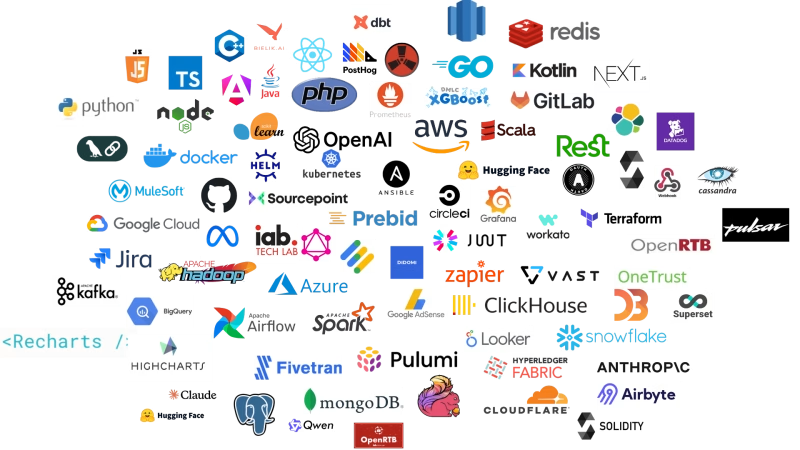
Most agency websites answer “what do you work with?” with a wall of logos. Ours did too. So here is the same wall, written out.


Bielik vs Qwen: just got spicier.
In one corner: Bielik, Poland’s community-built eagle: 11B parameters, now trained across 32 European languages, still Apache 2.0 and happy on a consumer GPU. In the other: Qwen 3.7 Max, Alibaba’s agent-first dragon with a 1M-token context window, 35-hour autonomous runs, and a catch: no open weights. API-only.
Because the fight changed. Qwen scores 56.6 on the Artificial Analysis Intelligence Index: #5 among all models, but every request now flies through Alibaba’s cloud at $2.50/$7.50 per million tokens. Bielik keeps your data in the building and your costs fixed. Sovereignty vs superpowers.
So: Bielik vs Qwen: eagle or dragon? Want to know more about Bielik vs Qwen? We are here :D
Disclaimer: this comparison was prepared in the context of creating Sandbot on Sandtime.io. Sandbot was built with Qwen 3.6-27B, hosted locally.
More about why and how we built Sandbot soon.
| Bielik (v3.0) | Qwen 3.7 Max | |
| Business model | Non-profit / community-driven, SpeakLeash research initiative | Corporate: Alibaba Cloud |
| Mission | Digital sovereignty for Poland and the CEE region, v3 extends to 32 European languages | Frontier agent race vs OpenAI / Google / Anthropic |
| Type | Regional model family: 1.5B, 4.5B, 7B Minitron, 11B | Proprietary flagship: “Agent Frontier” positioning |
| Target user | Public institutions, government, Polish/CEE companies and startups | Teams building long-horizon AI agents via API |
| Deployment philosophy | Edge / on-premise first, data never leaves the organization | API-only, no self-hosting option exists |
| Distribution | Open weights on Hugging Face | Alibaba Cloud Model Studio, OpenRouter, gateways |
| Bielik (v3.0) | Qwen 3.7 Max | Verdict | |
| Model size/hardware | ✓ 7B–11B parameters — runs on consumer GPU: Minitron-7B is 33% smaller with to 50% faster inference at avg. 90% quality (NIVIDIA collab) | ! Undisclosed size (MoE); irrelevant anyway – you can’t host it | 🏆 Bielik, the only one you can run at all |
| Context window | ✗ ~4k–8k tokens, still the biggest technical gap | ✓ 1M tokens native (991.8K input / 65.5K output), 4x Qwen 3.6 | 🏆 Qwen dramatically better |
| Deep reasoning | ✗ No thinking mode | ✓ Native extended thinking; GPQA Diamond 92.4, Terminal-Bench 2.0 69.7 | 🏆 Qwen significantly better |
| Multimodality | ✗ Text only | ! Max is text-only too – multimodal is the separate Qwen 3.7 Plus | – Tie on Max, Plus wins if version needed |
| Multilingual | ✓ Improved: v3 trained on 32 European languages, still strongest in PL | ✓ Broad global coverage, strong multilingual gains | 🏆 Bielik for PL/CEE, 🏆 Qwen elsewhere |
| Fine-tuning | ✓ Open weights + 3.2 TB public, domain-classified SpeakLeash corpus | ✗ Impossible, closed weights, no fine-tuning access | 🏆 Bielik |
| Framework compatibility | ! Ollama, LangChain, vLLLM/SGLang for v3; community tooling growing | ✓ OpenAI- and Anthropic-API compatible – works with Claude Code out of the box | 🏆 Qwen for API integration ease |
| License | ✓ Apache 2.0, full commercial freedom | ✗ Proprietary: the Apache 2.0 tie from the 3.5 era is gone | 🏆 Bielik |
| Update frequency | ! Community cadence (v3 Dec 2025, Minitron Mar 2026) | ✓ Breakneck: 3.5 → 3.6 → 3.7 in under 6 months | 🏆 Qwen |
| Bielik (v3.0) | Qwen 3.7 Max | Verdict | |
| Privacy/data control | ✓ Data physically never leaves your infrastructure | ✗ Every request goes to Alibaba’s servers: the on-premise option from Qwen 3.5 no longer exists in the 3.7 tier | 🏆 Bielik significantly better (gap widened) |
| Hybrid usage pattern | ✓ Still unique: Bielik as on-prem anonymizing pre-processor before a cloud frontier model | ! Qwen 3.7 can only ever be the cloud side of that pattern | 🏆 Bielik, now the ideal pairing partner for Qwen 3.7 |
| GDPR / jurisdiction | ✓ Polish project, EU data residency, AI Act-friendly by design | ✗ Chinese vendor + mandatory API = personal data leaves the EU; serious legal analysis required | 🏆 Bielik decisively better for EU |
| Support & partnerships | ! No SLA; growing network (NVIDIA collab shipped Minitron-7B, Ministry of Digitization) | ✓ Corporate SLA, uptime guarantees, multi-gateway availability | 🏆 Qwen for production support |
| Scalability | ! Manual hardware scaling | ✓ Automatic API scalling; built for 1000+ total calls and 35-hours runs (vendor-claimed, not independently verified) | 🏆 Qwen at scale |
| Vendor lock-in | ✓ Zero: open source | ✗ Worse than before: API-only means total dependency on Alibaba availability, pricing and geopolitics | 🏆 Bielik |
| Predictable cost | ✓ Fixed hardware cost, no per-token fees | ! $2.50 / $7.50 per 1M tokens via Alibaba ($1.25/$3.75 via OpenRouter), no fixed-cost option anymore | 🏆 Bielik |
| Auditability / certifications | ✓ Full on-prem control + public training documentation → ISO 27001 path | ✗ API-only kills the on-prem certification path that existed with 3.5 weights | 🏆 Bielik |
| Offline operation | ✓ Full, critical infrastructure ready | ✗ Impossible by definition | 🏆 Bielik |
The Qwen 3.7 release (May 2026) fundamentally changed this matchup. Previous versions of Qwen competed with Bielik on the same open-source terms, Qwen 3.7 Max is proprietary and API-only, with no downloadable weights. The comparison Bielik vs Qwen is no longer “small open model vs big open model” but “open, sovereign eagle vs closed, frontier dragon.”
Where Qwen 3.7 dominates: everything agentic. A 1M-token context window (vs Bielik’s ~4–8k), native extended reasoning, purpose-built MCP and tool calling, parallel tool execution, mature retry/fallback, and vendor-claimed 35-hour autonomous runs with 1,000+ tool calls. For multi-step agentic loop, Bielik’s weakest area, the gap widened dramatically. It also wins on scalability, SLA-backed support, update cadence, and drop-in integration (OpenAI- and Anthropic-API compatible).
Where Bielik dominates: everything sovereign. It’s the only one of the two you can actually run: Apache 2.0, consumer GPU, fully offline, fixed hardware costs, EU data residency, and a clean ISO 27001 path. Going API-only cost Qwen its privacy tie, its license tie, its fine-tuning option, and its predictable-cost story: every request now transits Alibaba’s cloud at per-token rates, with vendor lock-in and GDPR exposure on top. Bielik v3.0 also closed some ground: 32 European languages and the NVIDIA-collab Minitron-7B (33% smaller, up to 50% faster).
Bielik vs Qwen: the decision is now architectural, not technical. If clients accept cloud processing, Qwen 3.7 is the stronger engine for the agentic loop. If data can’t leave the building, Qwen 3.7 disqualified itself- the realistic options become Bielik, Qwen’s older open weights (3.5/3.6), or the hybrid pattern that got stronger with this release: Bielik on-prem as anonymizing pre-processor, a frontier model via API on scrubbed data.
PS. If you want to read about more AI comparisons see our post: AI vs our team ;)
Most agency websites answer “what do you work with?” with a wall of logos. Ours did too. So here is the same wall, written out.

AI vs ML isn’t semantics. Machine learning is the AI subset that predicts outcomes from data: it runs bidding, targeting, and fraud detection.
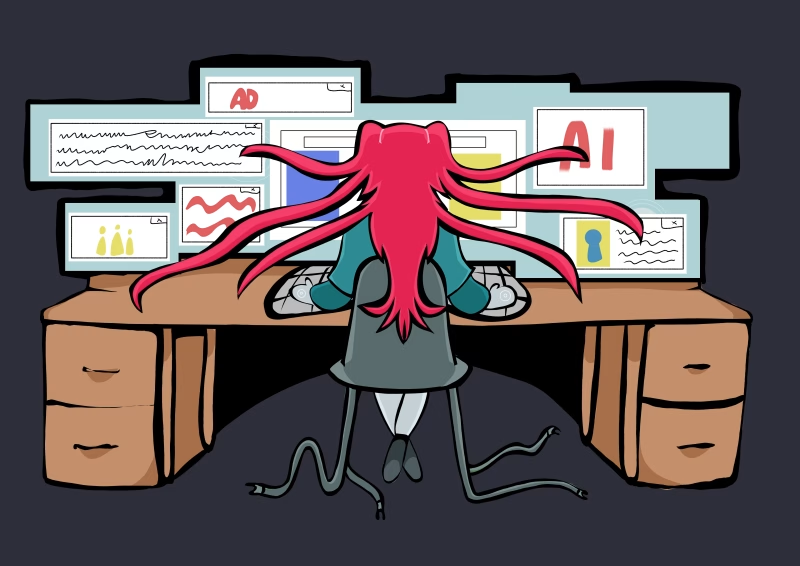
This is the honest breakdown: what agentic AI in advertising does in production, where it earns real ROI, and where it still spectacularly falls flat.