Article partially generated by artificial intelligence.
TL;DR: A DPIA (data protection impact assessment) is the written risk analysis that the GDPR requires before processing that is likely to result in a high risk to people, and for digital labour platforms it is no longer a judgement call: Article 8 of the Platform Work Directive, Directive (EU) 2024/2831 classifies every automated monitoring and decision-making system as high risk, requires the platform to seek the views of the people who work through it and their representatives, and requires it to hand the DPIA to workers’ representatives.
A useful DPIA for algorithmic management is built from an inventory of the real system: data fields, decisions, models and retention, with measures that are code changes. Sanddev, a software house in Wrocław, Poland, reviews and builds these systems.
This article is part of our series on platform work. The overview of the Platform Work Directive and the five features dispatch apps need covers the whole law; here we go deep on one obligation, the impact assessment, and show how to produce one that an engineer, a data protection officer and a union representative can all read.
Table of Contents
Key facts:
Article 8(1) of Directive (EU) 2024/2831 states that processing by automated monitoring or decision-making systems is likely to result in a high risk under Article 35(1) GDPR; Article 8(2) requires the platform to provide the assessment to workers’ representatives. Transposition deadline: 2 December 2026.
Article 35(7) of the GDPR lists four minimum contents of a DPIA, and Article 35(11) requires a review at least when the risk changes. Infringements of Article 35 can be fined up to EUR 10 million or 2% of worldwide annual turnover (Article 83(4)).
What is a DPIA and when is it mandatory for a platform?
A DPIA is a documented assessment of a planned processing operation: what it does and why, whether it is necessary and proportionate, what risks it creates for people and which measures address those risks. Under Article 35 GDPR it is mandatory where processing is likely to result in a high risk. For platforms, Article 8 of the directive settles that question for all automated monitoring and decision-making systems.
Before the directive, a platform could argue that its allocation engine or rating model did not reach the high-risk threshold. That argument was weak anyway. WP248 names evaluation or scoring “concerning the data subject’s performance at work”, automated decisions with legal or similar effects, systematic monitoring, large scale and vulnerable data subjects, explicitly including employees, among its nine criteria. A ride-hailing dispatch system meets at least four. The directive removes the debate and adds two procedural duties the GDPR only hints at: the views of platform workers and their representatives must be sought, and the finished assessment goes to the representatives.
The scope follows the directive’s definitions. Automated decision-making systems include those that decide on the allocation of tasks, on earnings, including the pricing of individual assignments, on working time and on restricting, suspending or closing accounts. Automated monitoring systems include anything that collects data to evaluate performance. In practice the DPIA has to cover the dispatcher, pricing and incentives, ratings and quality scores, fraud detection, identity checks, location tracking and the account enforcement pipeline.
What Article 8 adds to a GDPR data protection impact assessment
Question
GDPR Article 35 alone
With Article 8 of Directive 2024/2831
Is a DPIA required?
Only if high risk is likely; the controller decides, guided by WP248 and national lists
Always, for automated monitoring and decision-making systems
Whose views?
Data subjects or their representatives, “where appropriate” (Art. 35(9))
Persons performing platform work and their representatives must be consulted
Who sees the result?
No duty to publish; the authority on request or in prior consultation
The assessment must be provided to workers’ representatives
What must it cover?
The four elements of Art. 35(7)
The same, plus the processing limits of Article 7 (banned data)
Related duties
Prior consultation with the authority if high residual risk remains (Art. 36)
Information and consultation before introducing or substantially changing systems (Art. 13), evaluation every two years (Art. 10)
The last row matters for planning. Article 13 of the directive requires platforms to inform and consult platform workers’ representatives before decisions likely to introduce or substantially change automated monitoring or decision-making systems, and representatives may bring an expert of their choice, paid by the platform if it has more than 250 workers in the Member State. A DPIA written for a regulator only will not survive that conversation. Write it so an outside expert can follow every claim back to the system.
Which algorithmic management systems need a DPIA?
Every one of them, but each system triggers the assessment for different reasons. The table maps typical platform systems to the WP248 criteria, the Polish UODO list and the Article 7 bans most likely to be at stake. One DPIA may cover a set of similar operations (Article 35(1) GDPR), so a single document with one chapter per system is usually the most practical form.
System
WP248 criteria met
UODO list (2019) category
Article 7 risk to check
Task allocation and dispatch
Scoring, automated decisions, systematic monitoring, large scale
1, 2, 3, 12
Location collected outside working time
Pricing, surge and incentives
Automated decisions with financial effect, large scale
1, 2
Inferred traits used as pricing signals
Ratings and quality scores
Evaluation or scoring, vulnerable data subjects
1, 9
Emotional state inferred from complaints or chat
Fraud detection
Automated decisions, matching of datasets
2, 8
Data from private conversations
Identity and selfie checks
Biometric data, innovative technology
5, 10
One-to-many biometric identification
Deactivation and account enforcement
Automated decisions that block access to a service or contract
2, 11
Decisions taken without a human (Art. 10(5))
The UODO list follows the same logic as WP248: as a rule, processing that meets at least two of its criteria requires an assessment. Its examples include working time and information monitoring systems in workplaces, processing of employees’ location data and processing of data about people whose evaluation depends on an entity with supervisory or evaluating powers. A courier app hits all three.
What went wrong at Uber: a DPIA lesson from the Dutch decision
According to the EDPB summary of the Dutch decision, Uber’s systems temporarily deactivated driver accounts automatically on suspicion of fraud or after low customer ratings, and permanently deactivated accounts after persistently low ratings, without human involvement. Drivers lost income during deactivation and were not properly informed about the automated decision-making. The authority found infringements of Articles 22 and 13 GDPR.
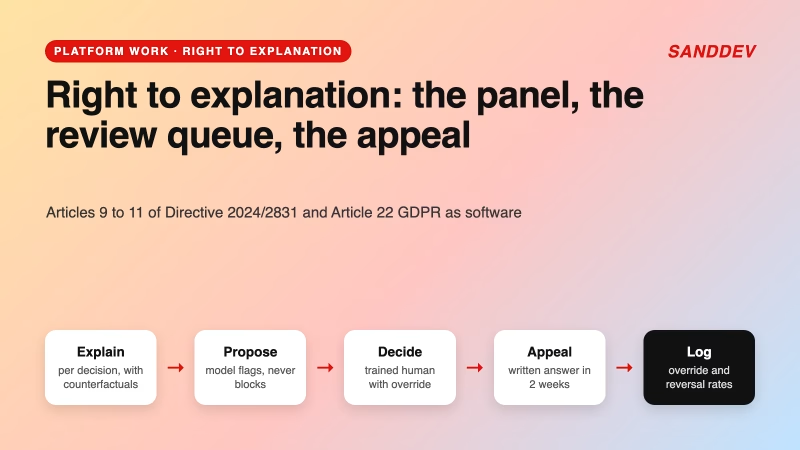
The published summary does not say anything about Uber’s DPIA, so we do not draw conclusions about it. The engineering lesson is still clear. An assessment that had traced each path from a fraud signal or a rating threshold to an account state change would have shown a fully automated decision with a significant effect, and the obvious measure, a human review step with the power to overrule the system, is a change in the code, not in the policy text. That is the standard to hold your own DPIA to: if it does not reach the decision paths, it cannot find the risk.
How to run a DPIA for algorithmic management, step by step
The method below produces an assessment that is traceable to the code and cheap to update. It assumes a team with access to the repository, the data warehouse and the people who run operations.
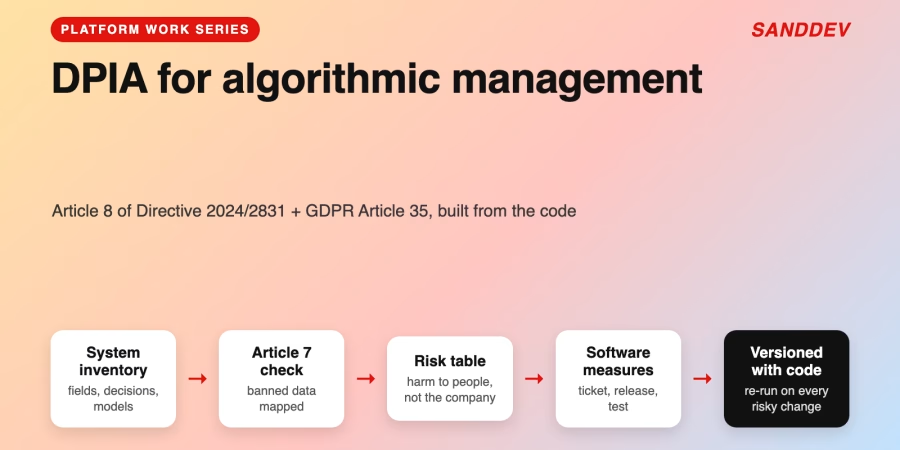
Build the system inventory. List every automated monitoring and decision-making system, its owner, its inputs, its outputs and the decision it takes or supports.
Map every data field. For each input record the source, purpose, legal basis, retention and whether it falls under any of the six Article 7 bans.
Trace each decision path. From signal to effect: which rule or model version, which threshold, which human step, which notification to the person.
Assess necessity and proportionality. For each field and decision, write why it is needed and what a less intrusive option would be.
Fill the risk table. Risks to people, not to the company: lost income, wrongful deactivation, discrimination, chilling of union activity, surveillance outside working time.
Define measures as software changes. Each measure gets a ticket, an owner, a release and a test that proves it works.
Consult workers and representatives. Share the draft, collect objections in writing and record how each one was handled.
Decide on residual risk. If high risk remains, consult the supervisory authority before going live (Article 36 GDPR).
Hand over and version. Provide the DPIA to workers’ representatives, store it next to the code and set the re-run triggers.
Start from a system inventory, not from interviews
Most DPIAs we see are written from workshops. They describe what the product team believes the system does. The code often does more: a location SDK that keeps sending pings after the driver goes offline, a support chat transcript that feeds a churn model, a rating field that a fraud rule reuses. An inventory extracted from schemas, event definitions, feature stores and model configs catches these. A minimal inventory row looks like this:
retention enforced by TTL or scheduled deletion jobs, with a report the DPO can read,
a decision log that records inputs, version, proposed outcome, final outcome and reviewer for every decision.
The risk table
Risk to the person
Source in the system
Likelihood and severity
Measure (software)
Account blocked on a false fraud signal
Fraud rule triggers enforcement directly
Likely, severe (income lost)
Model proposes, human decides; appeal SLA
Lower earnings from opaque allocation
Acceptance rate weighted in dispatch
Likely, significant
Weights documented and versioned; explanation screen
Surveillance outside working time
Location SDK runs in background
Possible, significant
Server-side cut-off, monitoring alert
Discrimination via proxies
Ratings correlate with protected traits
Possible, severe
Bias tests in the model pipeline, review of rating impact
Inference about union activity
Chat or forum data in a churn model
Unlikely, severe
Banned-field tags, CI check, separate channel not monitored
DPIA template structure: sections and what goes in each
Searchers ask for a DPIA template. Rather than a file to fill in, here is the structure we recommend for algorithmic management, built on the four elements of Article 35(7) GDPR and the extra duties of Article 8. Each section should link to evidence in the repository or the data platform.
Section
What goes in it
1. Summary and scope
Systems covered, version of the code and models assessed, date, owner, DPO opinion
2. Description of processing
System inventory, data flow diagram, purposes, legal basis, recipients, retention
3. Decision catalogue
Every automated decision, its effect on the person, the human step, the notification
4. Article 7 analysis
The six bans, the fields checked against each, evidence and result
5. Necessity and proportionality
Why each field and decision is needed, less intrusive alternatives considered
6. Risk assessment
Risk table with likelihood and severity for people
7. Measures
Software changes with ticket, release, test and owner; organisational measures
8. Consultation
Who was consulted, what they said, how it changed the design (Art. 35(9) GDPR, Art. 8 PWD)
9. Residual risk and sign-off
Remaining risk, decision on prior consultation (Art. 36), approval
10. Review plan
Re-run triggers, next review date, link to the two-year evaluation under Article 10
DPIA example: the deactivation pipeline
A short worked example shows the level of detail that works. The system: a nightly job computes a quality score from customer ratings, cancellations and fraud signals; below a threshold the account is flagged. Inventory: ratings (1 to 5, with free text), cancellation events, device fingerprint matches, trip GPS traces. Article 7 check: free-text comments may reveal health or emotional state, so the text is excluded from the score and only the numeric rating is used.
Decision path: flag, then an operations agent reviews evidence in a queue, then the agent decides, then the driver gets reasons and an appeal link. Main risks: wrongful loss of income, bias in customer ratings. Measures: the flag cannot change the account state; the reviewer must enter a reason code; ratings from customers with a history of outlier ratings are down-weighted; monthly reports compare deactivation rates across cities and vehicle types. Re-run trigger: any change to the score formula or the threshold.
When to re-run the DPIA and how to version it with the code
WP248 calls the DPIA “a continual process, not a one-time exercise”, and Article 35(11) GDPR requires a review at least when the risk changes. For an algorithmic system the risk changes with the code, so the review should be triggered by the code. Keep the DPIA as Markdown in the repository, next to the services it describes, and generate the inventory sections from schemas and configs on each release. Re-run the assessment when:
a new data source or field reaches a model or a rule,
model weights, thresholds or the scoring formula change,
a decision gains a new effect, such as a pay penalty or an account restriction,
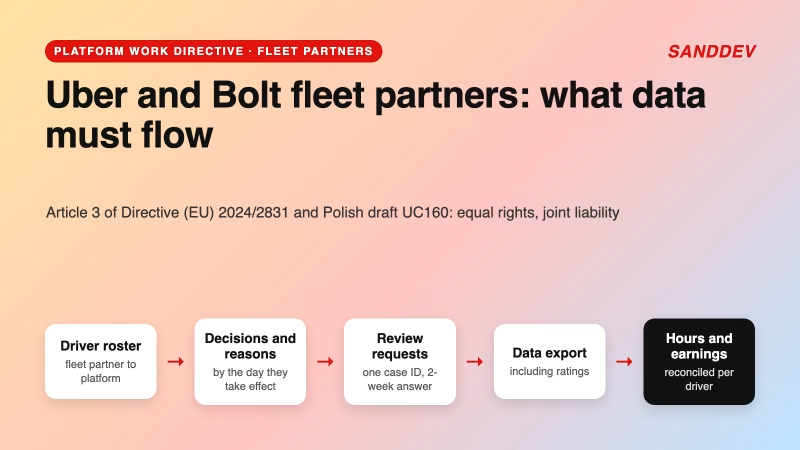
a new country, intermediary or fleet partner integration goes live,
the two-year evaluation under Article 10 or an appeal trend shows a problem,
an incident, a complaint to an authority or a new guideline changes the picture.
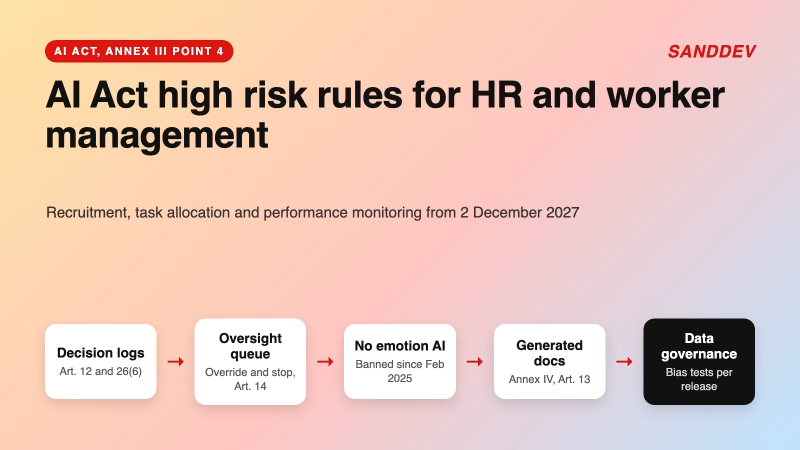
A pull request template with the question “does this change any item in the DPIA inventory?” and a code owner from the privacy team catches most of these. The AI Act points the same way: deployers of high-risk AI systems must use the provider’s instructions for use when carrying out a DPIA (Article 26(9) of the AI Act), and AI used for task allocation and the monitoring and evaluation of workers is high-risk from 2 December 2027 under the Digital Omnibus on AI. Employers outside platform work face the same questions about monitoring tools, covered in our article on the Quality Jobs Act and employee monitoring software.
How Sanddev helps with a DPIA for algorithmic management
Sanddev is a software house in Wrocław, Poland, with senior engineers only. Our software audit produces the system inventory a DPIA needs: every automated decision traced in the code, data fields mapped to the Article 7 bans with file and line evidence, retention checked against what the code actually does, and a fixed-scope list of the software measures. We can then build those measures with your team. The legal assessment, including the lawful basis and the employment status of the people concerned, is for your DPO and counsel; we make sure the document describes the system as it really works.
FAQ
What is a DPIA?
A DPIA, or data protection impact assessment, is the documented analysis required by Article 35 GDPR before processing that is likely to result in a high risk. It describes the processing, assesses necessity and proportionality, identifies risks to people and sets out the measures that address them.
Is a DPIA mandatory for digital labour platforms?
Yes for automated monitoring and decision-making systems. Article 8 of Directive (EU) 2024/2831 treats their processing as likely to result in a high risk under Article 35(1) GDPR, requires consultation of platform workers and their representatives and requires the DPIA to be provided to workers’ representatives.
Do we have to publish our DPIA?
The GDPR does not require publication, although WP248 recommends publishing at least a summary. Platforms must, however, give the assessment to workers’ representatives under Article 8(2) of the directive, and the supervisory authority can request it.
Is there an official DPIA template?
No single EU template exists. WP248 lists the criteria an acceptable DPIA must meet and refers to frameworks published by national authorities. For algorithmic management we recommend ten sections, from scope and system inventory to consultation, residual risk and a review plan.
How often should a DPIA be reviewed?
At least whenever the risk changes (Article 35(11) GDPR). For algorithmic systems that means changes to data sources, models, thresholds or effects of decisions. The directive also requires an evaluation of automated systems with workers’ representatives at least every two years.
Does the Polish UODO list cover platform systems?
Yes. The 2019 list includes evaluation and scoring, automated decisions with legal or financial effects, systematic monitoring of employees and processing of employees’ location data. Processing meeting at least two criteria generally requires a DPIA.
Who should write the DPIA?
The controller is responsible and must seek the advice of its data protection officer. In practice the document needs engineers who can trace decisions in the code, operations staff who run the review process and the DPO or counsel for the legal assessment.