Article partially generated by artificial intelligence.
TL;DR: Under the AI Act high risk regime, AI systems used to recruit people, decide on promotion or termination, allocate tasks based on behaviour or personal traits, or monitor and evaluate workers are high-risk systems (Annex III, point 4 of Regulation (EU) 2024/1689), and their obligations apply from 2 December 2027. Emotion recognition in the workplace has been prohibited since 2 February 2025.
Providers must build risk management, data governance, automatic logs, human oversight and documentation into the product; employers and platforms that deploy it must use it as instructed, assign trained human overseers, keep logs and inform workers’ representatives first. For dispatch and delivery apps this sits on top of the rules in our guide to the Platform Work Directive and algorithmic management. Sanddev, a software house in Wrocław, Poland, reviews and builds these parts of HR and platform software.
Key facts:
The AI Act entered into force on 1 August 2024. The prohibitions in Article 5, including emotion recognition at work, have applied since 2 February 2025.
Annex III, point 4 covers recruitment and selection, and decisions on terms of work, promotion, termination, task allocation and the monitoring or evaluation of performance and behaviour.
Prohibited practices can be fined up to EUR 35 million or 7 percent of worldwide annual turnover; breaches of most high-risk obligations up to EUR 15 million or 3 percent (Article 99).
Employers must inform workers’ representatives and the affected workers before a high-risk system is used at the workplace (Article 26(7)).
AI literacy duties under Article 4 have applied since 2 February 2025, and national authorities supervise them from 2 August 2026, according to the European Commission’s AI literacy Q&A.
Table of Contents
What does AI Act high risk mean for HR and worker management software?
It means that an AI system used in employment decisions must meet the requirements of Chapter III of the AI Act before it is placed on the market or used. The category is defined by purpose, not by technology: a gradient-boosted ranking model and a large language model that summarises CVs are treated the same way if they serve the same purpose.
Annex III, point 4 lists two groups of use cases in employment, workers’ management and access to self-employment:
Recruitment and selection (point 4(a)): placing targeted job advertisements, analysing and filtering applications, and evaluating candidates.
Decisions during the relationship (point 4(b)): decisions affecting terms of work-related relationships, promotion and termination, allocating tasks based on individual behaviour or personal traits or characteristics, and monitoring and evaluating the performance and behaviour of people in those relationships.
The wording is “work-related contractual relationships”, not employment contracts. A courier or driver working as self-employed through a platform is covered when the platform’s model allocates their jobs from their acceptance rate or ranks them by ratings. That is why the AI Act high risk rules matter to marketplaces as much as to corporate HR.
There is a narrow way out. Under Article 6(3), an Annex III system is not high-risk if it performs a narrow procedural task, improves the result of a completed human activity, detects deviations from earlier decision patterns without replacing human assessment, or performs a preparatory task. The exception never applies when the system profiles natural persons, and almost every allocation, scoring or monitoring model in HR profiles people. The provider must document the assessment before placing the system on the market.
Which HR tools fall into the high-risk category?
System
Typical classification
Why
CV screening or candidate ranking
High-risk, point 4(a)
Filters applications and evaluates candidates
Video or game-based interview scoring
High-risk, point 4(a); prohibited if it infers emotions
Evaluates candidates; emotion inference falls under Article 5(1)(f)
Targeted job ad delivery
High-risk, point 4(a)
Named explicitly in the annex
Shift scheduling based on past behaviour or performance
High-risk, point 4(b)
Allocates tasks based on individual behaviour
Dispatch that ranks couriers by acceptance rate or rating
High-risk, point 4(b)
Task allocation based on behaviour, with profiling
Productivity or performance scoring
High-risk, point 4(b)
Monitors and evaluates performance and behaviour
Attrition or “flight risk” prediction used for promotion or pay
High-risk, point 4(b)
Affects terms, promotion or termination
Sentiment analysis of employee calls or chats
Prohibited since 2 February 2025
Infers emotions in the workplace
Payroll calculation with fixed rules
Usually not an AI system
No inference; still subject to GDPR
Which AI practices in the workplace are already banned?
Article 5(1)(f) prohibits AI systems that infer the emotions of a natural person in the workplace or in education, except where the system is intended for medical or safety reasons. The ban has applied since 2 February 2025, so it is not affected by the Digital Omnibus postponement, and it carries the highest fines in the regulation.
The Commission guidelines on prohibited AI practices explain the boundary. Monitoring the tone of call centre agents, scoring candidates’ facial expressions in video interviews or flagging “frustrated” warehouse staff from webcams are inside the ban. Detecting a customer’s emotions in a support call is not covered by point (f), and a system that detects fatigue in a professional driver to prevent accidents can rely on the safety exception. The exception is read narrowly: a wellbeing score sent to a manager is not a safety system.
Article 5(1)(g) adds a second line: biometric categorisation that deduces race, political opinions, trade union membership, religious beliefs, sex life or sexual orientation from biometric data is prohibited too. For platforms the Platform Work Directive goes further, as Article 7 of Directive (EU) 2024/2831 bans processing data on the emotional or psychological state of platform workers by any automated monitoring or decision system, whether or not it is AI.
When do the AI Act high risk obligations apply to employers?
The obligations for Annex III systems, employment included, apply from 2 December 2027. The original date was 2 August 2026, and the Digital Omnibus postponed it. The prohibitions and AI literacy were not postponed, and the Platform Work Directive applies to platforms a year earlier.
Systems already on the market before 2 December 2027 fall under the high-risk rules only once they undergo significant changes in their design (Article 111(2)). Do not build a compliance plan on that: a dispatch or scoring model that gets new features and retraining every quarter is a weak candidate for the grandfather clause.
Date
What applies
1 August 2024
AI Act enters into force
2 February 2025
Prohibited practices (Article 5), including emotion recognition at work; AI literacy (Article 4)
2 August 2026
Supervision and enforcement of AI literacy by national authorities
2 December 2026
Transposition deadline of the Platform Work Directive
2 December 2027
Obligations for Annex III high-risk systems, including employment (point 4)
2 August 2028
Obligations for high-risk AI in products covered by Annex I
Article 4 asks providers and deployers to take measures so that their staff, and others who operate AI systems on their behalf, understand them well enough. The Digital Omnibus reworded the article without removing the duty. In practice, the HR team and the dispatch operators who act on model output need training on what the model does, where it fails and when to overrule it.
AI Act high risk duties: provider or deployer?
The provider develops the system and places it on the market or puts it into service under its own name; the deployer uses it under its authority. An HR software vendor is a provider and its customers are deployers. A platform that builds its own dispatch model is both, and so is an employer whose internal team builds a scoring tool.
Article 25 moves deployers into the provider role in three cases: when they put their name or trademark on a high-risk system, when they make a substantial modification to it, or when they change the intended purpose of a general system so that it becomes high-risk. Wrapping a general-purpose language model in a tool that ranks candidates is the third case, and it is common.
Area
Provider (builds the system)
Deployer (employer or platform using it)
Risk management
Continuous risk management system across the lifecycle (Art. 9)
Monitor operation and report risks and serious incidents (Art. 26(5))
Data
Training, validation and test data that are relevant, representative and examined for bias (Art. 10)
Input data relevant and sufficiently representative where the deployer controls it (Art. 26(4))
Documentation
Technical documentation (Art. 11, Annex IV) and instructions for use (Art. 13)
Use the system according to the instructions (Art. 26(1))
Logs
Automatic event logging built into the system (Art. 12)
Keep the logs under its control for at least six months (Art. 26(6))
Human oversight
Design the system so people can understand, override and stop it (Art. 14)
Assign overseers with competence, training and authority (Art. 26(2))
Accuracy and security
Declared accuracy, robustness and cybersecurity (Art. 15)
Report incidents and suspend use when the system presents a risk
Conformity
Quality management system, conformity assessment by internal control, EU declaration, CE marking, registration (Arts 17, 43, 47 to 49)
Public bodies register their use (Art. 26(8))
People affected
Enable deployers to explain output
Inform workers’ representatives and workers (Art. 26(7)), inform people subject to decisions (Art. 26(11)), explain individual decisions on request (Art. 86)
What must an employer or platform do as a deployer?
A deployer must use the system as the provider instructs, put trained people in charge of oversight, control the quality of the input data, monitor the system, keep its logs for at least six months and inform workers before use. People affected by a decision have a right to a clear explanation of the role the AI system played (Article 86).
Most of this is operational, not legal. The overseer named under Article 26(2) needs real authority: if a shift lead cannot change the schedule the model produced, there is no oversight. The information duty in Article 26(7) comes before the system goes live, and in many Member States it also triggers national consultation rules with works councils or trade unions. Candidates count as people subject to decisions too, so job applicants screened by a model must be told.
The fundamental rights impact assessment in Article 27 is narrower than often assumed. It binds deployers that are bodies governed by public law, private entities providing public services, and deployers of credit scoring and life or health insurance pricing systems. A private retailer using a scheduling model is usually outside it; a public hospital or a municipal transport company using the same model is inside.
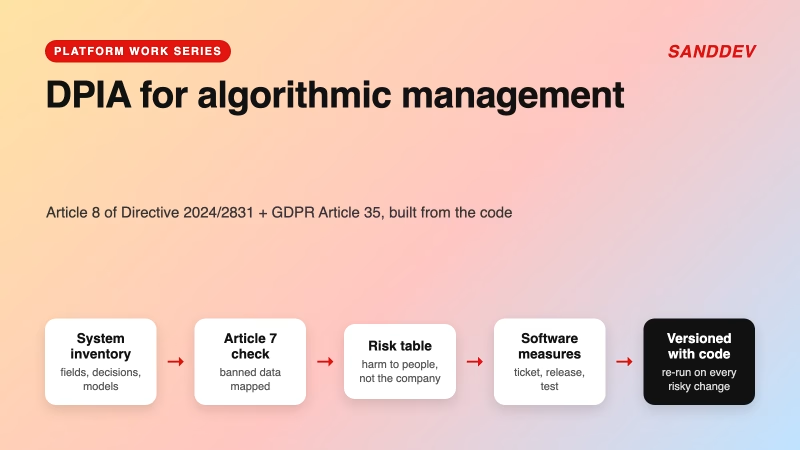
Where a FRIA is required, the Digital Omnibus lets the deployer cross-reference the matching sections of its DPIA instead of repeating them (Article 27(4)). Either way, the GDPR already requires a data protection impact assessment for systematic evaluation of workers, and Article 26(9) tells deployers to use the provider’s instructions when writing it. Our walkthrough of a DPIA for algorithmic management shows how to build one from a data inventory.
What must the provider of HR or dispatch AI build?
The provider carries most of the engineering work: a documented risk management process, governed training data, automatic logs, a design that supports human oversight, measured accuracy and robustness, technical documentation and a quality management system. For Annex III point 4 the conformity assessment is internal control, so no notified body is involved, but the evidence must exist.
In practice this means the requirements land in the backlog, not in a policy binder. Risk management (Article 9) is a register of foreseeable harms, such as indirect discrimination against part-time workers or older candidates, with tests that prove each mitigation works. Data governance (Article 10) is lineage for every training set, documented collection and labelling, and bias examination by protected group, with special categories of data processed only where strictly necessary to detect and correct bias, under the safeguards of the new Article 4a added by the Digital Omnibus. Post-market monitoring (Article 72) is a pipeline that compares live outcomes with the validation results.
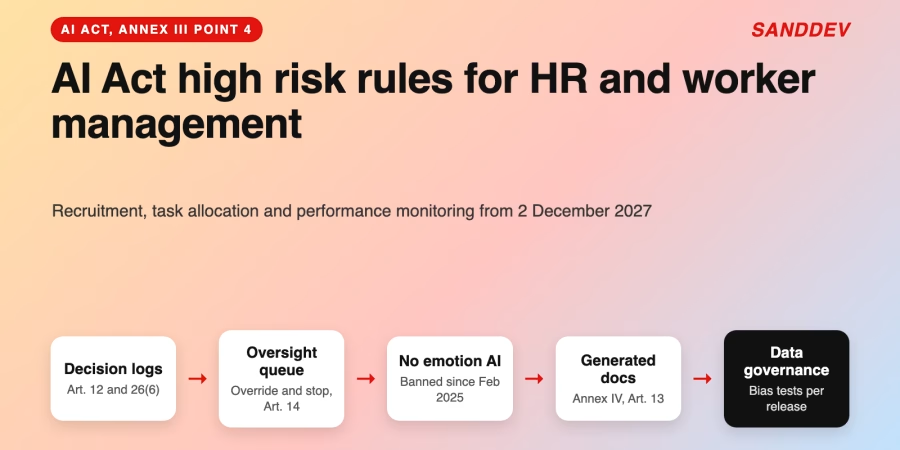
What to build: logs, oversight screens, documentation and data controls
These four components cover most of the AI Act high risk requirements on both sides of the provider and deployer split. They are also the parts we most often find missing when we review HR and dispatch systems.
Decision logs that serve the AI Act and the directive
Article 12 requires automatic recording of events over the lifetime of the system, enough to identify risks, support post-market monitoring and let the deployer monitor operation. One append-only log can serve the AI Act, the Platform Work Directive and the GDPR if it records:
the decision type (shortlist, shift, job offer, rating impact, flag) and the subject’s pseudonymous ID,
model name and version, feature set version, configuration and thresholds in force,
the input feature values or a hash and pointer to them, and the output with its score or confidence,
the overseer who reviewed it, the action taken (accepted, changed, rejected) and the reason code,
timestamps for proposal, review, effect, explanation sent and any challenge,
retention of at least six months for deployers, longer where labour law limitation periods require it.
A human oversight screen, not a rubber stamp
Article 14(4) describes what overseers must be able to do: understand the system’s capacities and limits, stay aware of automation bias, interpret the output correctly, decide not to use it, override it and stop the system. Human in the loop only counts if the interface supports that. Build a review queue that shows the score with its main factors, the data it was based on and known limitations; requires a reason code for acceptance as well as for rejection; and records the time spent. A reviewer who confirms 400 rankings an hour is evidence against you.
Documentation generated from the system
Technical documentation (Annex IV) and instructions for use (Article 13) go stale fast when written by hand. Generate model cards, feature lists, accuracy metrics by subgroup and change history from the model registry and the CI pipeline, and version them with each release. Deployers then receive the same facts they need for worker information, the DPIA and the explanation under Article 86.
Data governance at the feature level
an inventory of every feature that reaches a model, tagged with source, legal basis and whether it is a proxy for a protected characteristic,
automated checks that block emotion, health or private communication data from reaching employment models,
bias tests per release on selection rates and error rates by group, with thresholds that fail the build,
drift monitoring on live inputs and outcomes, feeding the provider’s post-market monitoring.
Platforms: where the AI Act meets the Platform Work Directive
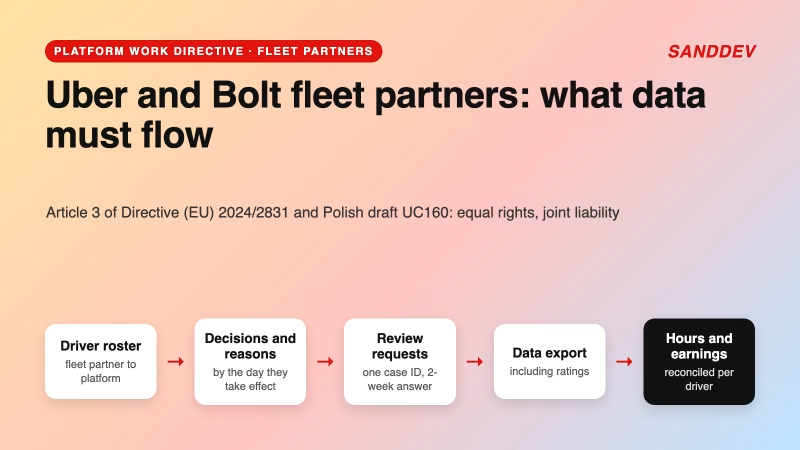
A dispatch algorithm that allocates jobs to couriers by behaviour is regulated twice: as algorithmic management under the Platform Work Directive from its national transposition, and as a high-risk AI system from 2 December 2027. The rules overlap, but the directive is stricter on decisions about accounts and on banned data.
Topic
AI Act
Platform Work Directive
Scope
AI systems only, in Annex III use cases
Any automated monitoring or decision system, AI or not
Emotions
Emotion inference banned at work, with medical and safety exceptions
No processing of emotional or psychological state data
Human role
Trained overseers who can override and stop the system
A human takes every decision to restrict, suspend or terminate an account
Information
Workers and representatives informed before use
Detailed information on systems, parameters and their weight
Explanation
Right to an explanation of individual decisions
Written reasons and review within two weeks
Impact assessment
FRIA for certain deployers; GDPR DPIA
DPIA mandatory, with consultation of the people affected
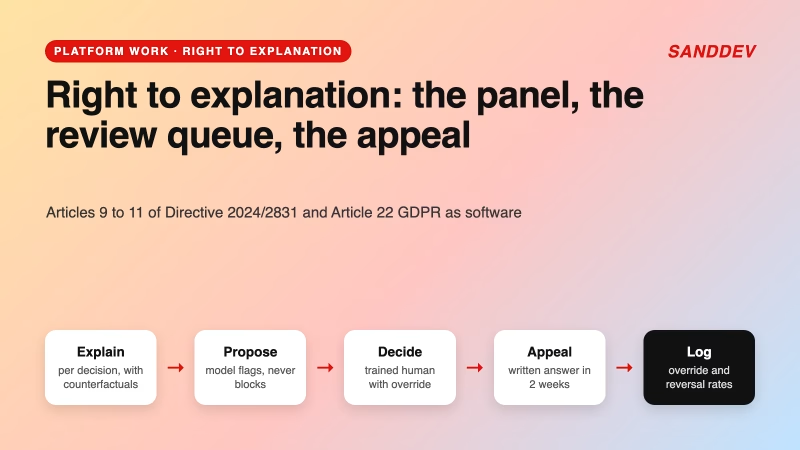
The practical answer is to build once for the stricter rule. The decision log, the reviewer queue and the explanation screen described in the pillar guide also satisfy Articles 12, 14 and 86 of the AI Act if the log carries model versions and the queue carries override rights. Ordinary employers may soon face similar duties: the Commission plans a Quality Jobs Act with algorithmic management among its priorities, and our article on the Quality Jobs Act and employee monitoring software follows that proposal.
AI Act high risk readiness checklist for HR and dispatch systems
List every AI component that touches recruitment, scheduling, allocation, ratings, performance or termination, and note who built it.
Classify each one against Annex III point 4 and Article 6(3), and record the reasoning.
Remove anything that infers emotions of workers or candidates, unless it is a genuine medical or safety system.
Decide where you are provider, deployer or both, including Article 25 cases where you rebrand or repurpose a model.
Add decision logs with model version, inputs, output, reviewer and outcome, retained for at least six months.
Build the oversight queue with explanations, reason codes, override and stop controls, and train the overseers.
Generate technical documentation and instructions for use from the model registry and CI.
Run bias and accuracy tests per release, and monitor drift in production.
Inform workers’ representatives and workers before go-live, write the DPIA, and check whether Article 27 applies to you.
How Sanddev reviews and builds high-risk HR systems
Sanddev is a software house in Wrocław, Poland, working since 2016 with senior engineers only. Our software audit covers AI used in recruitment, scheduling, task allocation and performance evaluation: we trace each model from training data to the decision it drives, check logs, oversight paths and data flows against Annex III and Articles 9 to 15 and 26, and give file and line evidence. Missing pieces, such as the decision log, the reviewer queue or generated documentation, are quoted as a fixed-scope stage that we can build with your team.
We assess what the software does. Whether a given system is high-risk in your context, and what your works council agreements require, are questions for your legal counsel.
FAQ
Is AI used in recruitment high-risk under the AI Act?
Yes. Annex III, point 4(a) makes AI systems used to place targeted job ads, analyse and filter applications and evaluate candidates high-risk. The obligations apply from 2 December 2027, after the Digital Omnibus postponement.
When do the AI Act high risk obligations for HR systems apply?
From 2 December 2027. The Digital Omnibus on AI, Regulation (EU) 2026/1744, moved them from 2 August 2026. The ban on emotion recognition at work and the AI literacy duty have applied since 2 February 2025.
Can an employer use AI to detect employees’ emotions?
No, unless the system is intended for medical or safety reasons. Article 5(1)(f) of the AI Act has prohibited emotion inference in the workplace since 2 February 2025, with fines of up to EUR 35 million or 7 percent of worldwide turnover.
Is a shift scheduling or dispatch algorithm high-risk?
It is when it allocates tasks based on individual behaviour or personal traits, for example acceptance rates, ratings or past performance. Scheduling based only on stated availability may fall under the Article 6(3) exception, but not if it profiles people.
What is the difference between a provider and a deployer?
The provider develops the system and places it on the market under its name; the deployer uses it. A company that builds its own model, rebrands a vendor’s system or repurposes a general model for HR decisions becomes a provider under Article 25.
Do employers have to carry out a fundamental rights impact assessment?
Only some. Article 27 applies to public bodies, private entities providing public services and certain credit and insurance deployers. Most private employers are outside it, but they still need a GDPR data protection impact assessment.
Do platforms need to comply with both the AI Act and the Platform Work Directive?
Yes. A dispatch or rating model is algorithmic management under the directive and, if it uses AI to allocate tasks or evaluate workers, a high-risk system under the AI Act. One set of logs, oversight screens and explanations can serve both.