


- AdTech
- MarTech
Why AdTech and MarTech infrastructure keeps breaking
The hardest problems in AdTech and MarTech infrastructure are structural, not feature-level. Read why and how to solve it.

TL;DR: AI vs ML isn’t semantics. Machine learning is the AI subset that predicts outcomes from data: it runs bidding, targeting, and fraud detection. AI in 2026 also covers generative and agentic systems that create and orchestrate. Buy ML for prediction, generative AI for creation, agentic AI for autonomy. Mislabel them and you overpay.
The difference in AI vs ML is scope: AI is any system mimicking human intelligence, while ML is the subset that learns patterns from data to make predictions. Every ML model is AI; not every AI is ML. In AdTech, ML is the workhorse: it predicts your CTR before the impression even loads. AI is the umbrella your vendor’s sales deck is hiding under.
The AI vs ML difference matters because you pay for different jobs. AI-driven programmatic spend hit $134.8 billion, growing 18% year-over-year, but most of that AI is classic ML doing predictions. Meanwhile 54% of advertisers say generative AI has contributed to a decline in media quality, and $26.8 billion was lost to programmatic waste and inefficiencies in 2025. Buying the wrong layer of “AI” for your problem is how budgets quietly bleed.
ML does the heavy lifting in bidding, targeting, and fraud detection: the prediction jobs. ML-optimized campaigns see 10–30% higher conversion rates than non-AI programmatic, AI-driven bid optimization cuts CPA by an average of 18%, and 80% of Google Ads users already run automated bidding. None of this writes a headline. It predicts numbers, fast, at auction speed.
Beyond ML, AI adds creation and autonomy. Generative AI writes copy and spins creative variants: 65% of US advertisers have adopted generative AI tools. Agentic AI goes further: it orchestrates spend, creative, and audience strategy across channels with minimal human babysitting. See more about agentic AI in advertising, what it actually does in 2026.
Think three layers: ML predicts, generative AI creates, agentic AI decides. We break down the full stack in our guide AI in AdTech and MarTech: what works in 2026.
Ask what the model predicts, what data trains it, and how often it retrains. If the answer to “how does your AI work?” is a shrug and a buzzword, you’re buying ML from 2015 with a 2026 price tag. Real AI vs ML transparency looks like: named model types, measurable lift, and retraining cadence. No specifics, no signature.
Read here how AI is revolutionizing AdTech and MarTech.
AI is any system that mimics human intelligence: reasoning, prediction, creation, or decision-making.
ML is a subset of AI that learns patterns from data to make predictions without explicit programming.
Deep learning is ML using multi-layered neural networks to find complex patterns in large datasets.
A neural network is an ML architecture of connected nodes that processes data in layers, loosely inspired by the brain.
Generative AI creates new content like ad copy, images, video variants, from learned patterns.
Reinforcement learning is ML that improves through trial, error, and reward: the logic behind self-tuning bid strategies.
Unsupervised learning is ML that finds hidden patterns in unlabeled data, like discovering audience clusters nobody defined.
Predictive bidding is ML estimating an impression’s conversion probability and adjusting the bid in real time.
Bid shading is ML predicting the lowest winning bid in first-price auctions so you stop overpaying for impressions.
Inference is a trained ML model making live predictions in production: the millisecond math behind every auction decision.
Supervised learning is ML trained on labeled data: e.g., past clicks, to predict future outcomes.
Training data is the historical dataset an ML model learns from; bad data means bad predictions.
Model drift is ML accuracy decaying as consumer behavior shifts, requiring regular retraining.
The hardest problems in AdTech and MarTech infrastructure are structural, not feature-level. Read why and how to solve it.

In one corner: Bielik, Poland’s community-built eagle. In the other: Qwen 3.7 Max, Alibaba’s agent-first dragon. Which AI model is better?
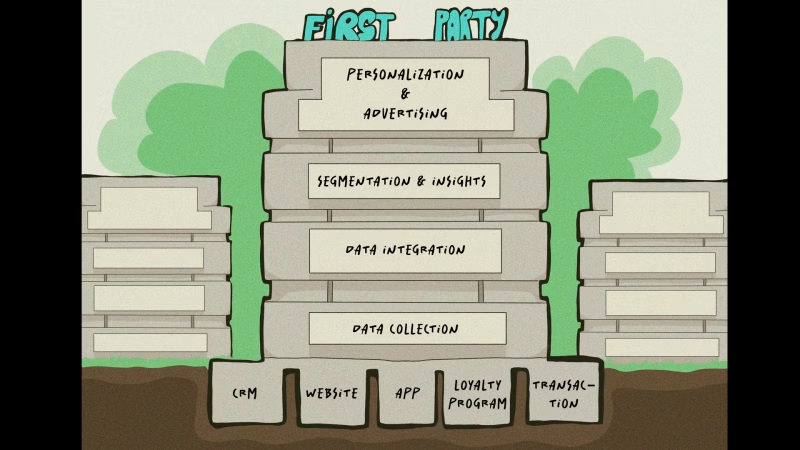
Third-party data is rented. First-party data is owned, and in 2026, ownership is the whole game.