Article partially generated by artificial intelligence.
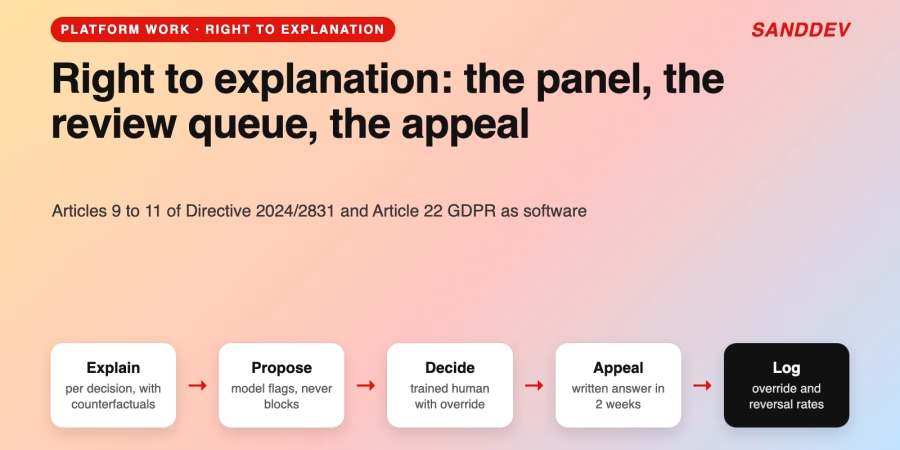
TL;DR: The right to explanation means that a driver, courier or freelancer can learn why an automated system allocated, priced, rated or blocked them, talk to a person about it and get the decision reviewed. Under Articles 9 to 11 of Directive (EU) 2024/2831 and Article 22 GDPR, a platform needs three pieces of software: an in-app explanation panel, a review queue in which the model proposes and a human decides every suspension, and an appeal workflow that answers in writing within two weeks. Sanddev, a software house in Wrocław, Poland, reviews and builds these parts of platform software.
This article is the product and engineering deep dive of our series. For the legal overview, deadlines and the full list of obligations, start with our guide to the Platform Work Directive and algorithmic management. Here we stay with one question: what exactly do you build so that a decision about a person can be explained, reviewed and corrected.
Table of Contents
Key facts:
Article 11 of the directive creates a right to explanation for every person performing platform work: an explanation of any decision taken or supported by an automated system, without undue delay, and access to a named contact person.
A decision to restrict, suspend or terminate an account must be taken by a human being (Article 10(5)), and a review request must be answered in writing within two weeks (Article 11(2)).
Article 22 of the GDPR already gives people the right not to be subject to a decision based solely on automated processing with legal or similarly significant effects, and the right to human intervention and to contest it.
On 27 February 2025 the Court of Justice ruled in C-203/22 Dun & Bradstreet Austria that a controller must explain the procedure and principles actually applied, and that handing over an algorithm is not enough.
What is the right to explanation for platform workers?
The right to explanation is the right of a person affected by an automated decision to receive a clear, specific account of why that decision was made about them, and to have it reviewed by a human. For platform work it comes from two sources that overlap: Article 22 and Article 15(1)(h) of the GDPR, and Articles 9 to 11 of the Platform Work Directive.
The GDPR layer covers decisions based solely on automated processing that produce legal or similarly significant effects. Where such a decision is allowed, Article 22(3) requires at least the right to obtain human intervention, to express one’s point of view and to contest the decision, and Article 15(1)(h) gives a right to “meaningful information about the logic involved”. The directive goes further for platform work. It applies to decisions taken or supported by automated systems, so a model that only recommends is still in scope, and it adds concrete deadlines and a contact person.
Drivers type “uber deactivation appeal” or “uber account deactivated” into Google when this goes wrong. Those searches describe the moment your product either works or fails: a person has lost income and wants to know why. The rest of this article is about designing that moment.
Automated decision making under GDPR and the directive: what the law asks of your product
Automated decision making under GDPR and the directive comes down to five product requirements: tell people in advance how the system decides, explain each significant decision on request, give written reasons for account restrictions on the day they take effect, let a human decide restrictions, and answer review requests in writing within two weeks, correcting wrong decisions within another two.
Legal source
What it requires
Product feature
Directive Art. 9(1) to (3)
Categories of decisions, data, main parameters and their relative importance, grounds for restriction; given by the first working day, before changes and on request
Versioned “How decisions work” page generated from configuration
Directive Art. 10(1) to (3)
Regular human oversight, at least every two years, by staff with competence, training and authority to override
Reviewer roles, training records, override button, evaluation reports
Directive Art. 10(5)
A human takes any decision to restrict, suspend or terminate the account or contract
Account actions locked behind a reviewer decision
Directive Art. 11(1)
Explanation without undue delay; contact person; written statement of reasons at the latest on the day a restriction takes effect
Explanation panel, contact channel, statement of reasons generator
Directive Art. 11(2) and (3)
Written, substantiated answer to a review request within two weeks; correction within two weeks or compensation
Appeal workflow with SLA timers and a remedy step
GDPR Art. 22(3), 15(1)(h)
Human intervention, right to contest, meaningful information about the logic
Same appeal workflow, plus explanation in access requests
The Polish draft act on platform work (UC160) repeats the two-week deadline and adds one of its own: a person who asks why the cooperation ended must get an answer within seven days. Whether a given decision has “similarly significant effects” or which Member State rules apply is a question for your counsel. The engineering work is the same either way.
What does the CJEU require from an explanation after C-203/22?
In Dun & Bradstreet Austria the Court of Justice held that the explanation must describe the procedure and principles actually applied, so that the person understands which of their data were used and how. It suggested showing how a change in the data would have changed the result, and said that giving someone the algorithm itself is not a concise and intelligible explanation.
The case concerned an automated credit check, but the reasoning carries over to a dispatch or rating engine. Three design consequences follow from the Court’s press release on C-203/22:
Explain this decision, not the model in general. A generic FAQ about “our algorithm considers many factors” fails the test. The panel has to show the inputs that mattered for this driver on this day.
Counterfactuals are the expected format. “If your acceptance rate in the last 7 days had been above X, this order would have been offered to you” is the kind of statement the Court described. Your system must be able to compute it, which means storing the inputs and the threshold at decision time.
Trade secrets are not a blanket refusal. Where the controller believes the information contains trade secrets or third-party data, it must give that information to the supervisory authority or the court, which balances the interests. Plan an internal “full explanation” export that can be handed over under seal.
An explainable algorithm in this sense is not about the model architecture. A gradient-boosted model can be explainable if you log feature contributions per decision; a simple rule set can be unexplainable if nobody recorded which rule fired.
What should the in-app explanation panel show?
The explanation panel should show, for each significant decision, what was decided, when, which data categories and main parameters drove it with their relative weight, what the person could change to get a different result, whether a human was involved, and how to contact a person or request a review. The right to explanation is met only when the panel uses the person’s own data, not a generic description.
Article 9 sets the floor for the general information and Article 11 for the individual decision. In practice we design two layers: a static, versioned “How decisions work” page per decision type, and a per-decision “Why did this happen” card that links to it. The table below is the starting point we use for ride-hailing and delivery apps.
Decision
What the person sees
Data behind it (logged per decision)
Human role
Allocation (who gets an order)
Main factors for this offer: distance or ETA, vehicle type, current queue position; which factor ruled you out; what would have changed it
Candidate list, scores per factor, weights version, rule that excluded the person, timestamp
None per decision; parameters reviewed at least every two years (Art. 10(1))
Pricing and earnings
Base fare, distance and time components, surge or incentive applied, deductions, final payout; reason for any refused payment
Price inputs, multiplier and its trigger, deduction codes, pricing config version
A human reviews any refusal to pay on request (Art. 11)
Rating and quality score
Current score, which trips or reviews count, which were excluded and why, how the score affects allocation or access
Rating events, exclusion rules applied (for example rider-caused cancellation), score formula version
Contested ratings go to the review queue
Account status (warning, restriction, suspension, deactivation)
What is restricted, from when, until when, the specific facts relied on, the statement of reasons, the reviewer’s decision, the review button and the deadline
Model or rule flag, evidence bundle, reviewer ID, reviewer notes, decision and effective time
A trained reviewer takes the decision (Art. 10(5)); a different reviewer handles the appeal
Design rules for the explanation panel
Plain language, one screen. Lead with the decision and the top two or three factors. Put the full list one tap away.
Show relative importance, not raw coefficients. “High, medium, low influence” or a ranked list meets the Article 9 wording on relative importance without publishing weights that can be gamed.
Generate, do not write. The text is rendered from the decision record and the configuration version. If someone changes a weight, the panel changes with it, and Article 9(3) requires notice before such a change.
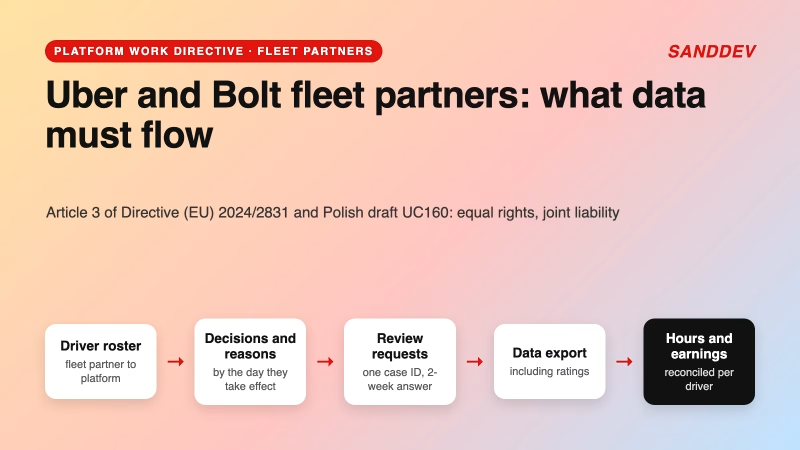
Same content for fleet partner drivers. When a driver is engaged through an intermediary, the explanation must still reach them; our article on what the directive means for Uber and Bolt fleet partners covers the data exchange between the two systems.
Language and accessibility. Translate into the languages your workforce actually uses and test with screen readers. An explanation nobody can read does not meet the “intelligible” requirement.
How does human in the loop AI work for account suspensions?
Human in the loop AI for suspensions means the model can only flag and propose; a trained reviewer with authority to override sees the evidence, decides and records the reasons, and only that decision changes the account. The reviewer must be able to reject the proposal without penalty, and the system must measure whether they ever do.
The Uber case shows why the word “decides” matters. The Dutch authority found that deactivations for suspected fraud and low ratings were fully automated. A queue in which humans click “confirm” on every proposal would bring you back to the same finding, because the Article 29 Working Party guidelines on automated decision-making, endorsed by the EDPB in 2018, say human involvement must be meaningful, not a token gesture, and carried out by someone with the authority and competence to change the decision.
Anatomy of a reviewer queue
Flag. A rule or model raises a case with a reason code, a confidence value and the evidence it used. No account action happens yet, except a temporary safety hold where your counsel has confirmed it is justified; that hold is itself a restriction and enters the queue with priority.
Evidence bundle. The reviewer sees the trips, GPS traces, payment events, complaints or document checks that triggered the flag, plus context the model may not weigh: tenure, past appeals, the driver’s own notes.
Hidden proposal option. For a share of cases, show the evidence before the model’s proposal. This tests whether reviewers reach the same answer on their own and reduces automation bias.
Decision with reasons. The reviewer chooses no action, warning, restriction, suspension or termination, picks the facts relied on and writes a short note. The statement of reasons is generated from these choices, not from the model output.
Delivery. The statement of reasons reaches the person in the app and by e-mail no later than the day the decision takes effect (Article 11(1)), with the review button and the deadline.
Second pair of eyes for appeals. An appeal goes to a different reviewer, who can see the first decision but is measured on independent outcomes.
How should a deactivation appeal work, step by step?
A deactivation appeal should open from the statement of reasons in one tap, let the person add their account and evidence, route the case to a reviewer who did not take the first decision, and produce a written, substantiated answer within two weeks. If the decision was wrong, the account is restored and lost earnings are corrected or compensated within a further two weeks.
Uber already runs a deactivation review process for drivers, but it does not publish a response time. The directive turns the response time into a hard deadline, so the workflow needs timers, escalation and a remedy step, not a shared inbox.
Intake: request ID, decision ID, free-text statement, uploads (photos, receipts, screenshots), preferred language, consent to share with a representative.
Clock: the two-week timer starts when the request is received, not when someone opens it. Alert at day 7 and day 10; escalate to a team lead at day 12.
Contact person: the person can talk to the designated contact, by chat or phone, who has the competence and authority Article 11(1) requires, and the conversation is attached to the case.
Answer: a written reply that addresses the person’s arguments, names the facts relied on and states the outcome. A template that ignores the evidence they sent is not “duly substantiated”.
Remedy: if the appeal succeeds, reactivate the account, recalculate earnings for the period of the restriction, restore the rating or queue position where it matters, and log the compensation paid. Article 11(3) also requires changes to the system when the error came from it.
Rubber stamp or real review? How to tell the difference
Regulators will not take your word that humans decide. They will look at the logs. The comparison below is how we assess an existing review process in a code and data review.
Cannot reverse the model or needs approval to do so
Can reject without approval and is protected for doing so (Art. 10(2))
Reviewer targets
Cases closed per hour
Quality sampling, appeal reversal rate
Appeal reviewer
Same person or same team metric
Different reviewer, independent outcome tracked
Feedback to the model
None
Overrides and successful appeals feed the evaluation under Art. 10(1)
Which metrics and logs prove the right to explanation works?
To prove the right to explanation works, log every automated decision as an immutable event with its inputs, version and explanation, link every human decision and appeal to it, and report override rate, time to statement of reasons, appeal volume, appeal reversal rate and two-week SLA breaches by decision type. These numbers feed the two-yearly evaluation under Article 10.
system and config_version or model_version, input_snapshot_ref (data categories and values used), top_factors with relative weight
counterfactual (the threshold or change that would have altered the result), proposed_outcome, final_outcome
reviewer_id, reviewer_notes, evidence_viewed (which items were opened), review_started_at, review_ended_at
reasons_sent_at, appeal_id, appeal_received_at, appeal_answered_at, remedy and compensation_amount
Store it append-only, with access logging, and keep the input snapshot as long as an appeal, a court case or a data access request may need it; the retention period is a decision for your data protection officer. Logging evidence_viewed is the single best defence against the rubber-stamp finding: it shows that a reviewer actually opened the trip and the complaint before deciding.
Dashboard for ops and compliance
override rate per reason code and per reviewer, with outliers in both directions flagged,
median and 95th percentile time from flag to decision and from decision to statement of reasons,
appeals per 1,000 restrictions, appeal reversal rate, and appeals answered after day 14,
compensation paid after reversals, which shows the cost of a bad rule in money,
share of decisions where the explanation panel was opened, a cheap proxy for whether people understand it.
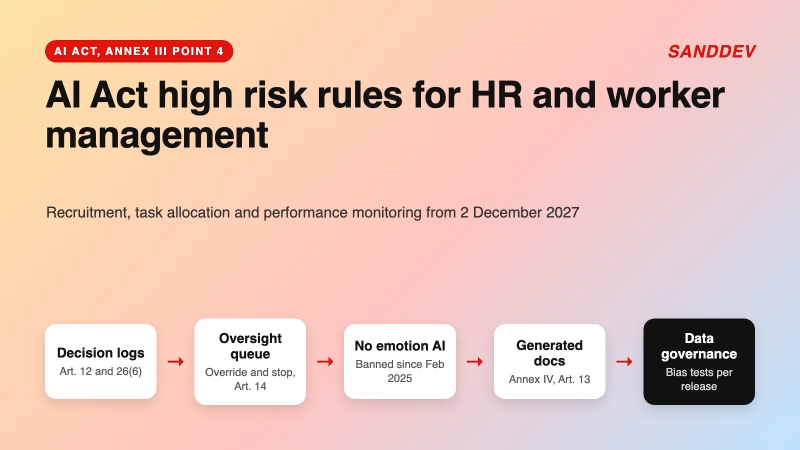
The same records will carry you into the AI Act: systems that allocate tasks or evaluate workers are high-risk, and our article on AI Act obligations for high-risk HR and workforce systems shows how human oversight and logging requirements there line up with this design.
Right to explanation checklist for product and engineering teams
List every decision type that affects allocation, earnings, rating or account status, and mark which are taken or supported by an automated system.
For each, store the inputs, the configuration or model version and the top factors at decision time, so an explanation can be rebuilt later.
Build the “How decisions work” page from configuration and send notice before any change to parameters or weights.
Add the per-decision explanation card with counterfactuals for allocation, pricing, rating and account status.
Lock every restriction, suspension and termination behind a reviewer decision, with evidence shown before the model’s proposal for a sample of cases.
Generate the statement of reasons from the reviewer’s choices and deliver it by the day the decision takes effect.
Build the appeal workflow with a two-week timer, escalation, a different reviewer and a remedy step for earnings and ratings.
Name and train contact persons and reviewers, record their training and give them written authority to override.
Report override and appeal metrics monthly and feed them into the evaluation under Article 10.
Prepare a sealed “full explanation” export for a supervisory authority or court, in line with C-203/22.
How Sanddev builds explanation panels and review queues
We start by reading the code: where each decision is made, what data it uses, whether any account action can run without a human, and whether the logs would let you rebuild an explanation for a decision taken six months ago. The result is a list of gaps with file and line evidence. Then we design and build the explanation panel, the reviewer queue and the decision logs as custom software that fits your stack, working with your team so that the knowledge stays in-house.
We work on what the software does. Whether a particular decision falls under Article 22 GDPR, and how national transposition applies to your workers, is a legal question for your counsel.
FAQ
What is the right to explanation in automated decision making?
It is the right of a person affected by an automated decision to get a clear account of why it was made, based on the procedure and principles actually applied to their data, and to have it reviewed by a human. For platform workers it comes from Article 22 and Article 15(1)(h) GDPR and Articles 9 to 11 of Directive (EU) 2024/2831.
Does automated decision making under GDPR ban algorithmic deactivations?
Article 22 GDPR prohibits decisions based solely on automated processing with legal or similarly significant effects unless an exception applies, and then requires human intervention and a right to contest. The Platform Work Directive is stricter: any decision to restrict, suspend or terminate a platform worker’s account must be taken by a human.
How long does a platform have to answer a deactivation appeal?
Two weeks from receipt of the request, with a written and substantiated reply (Article 11(2) of the directive). If the decision infringed the person’s rights, the platform must correct it within two weeks or, if that is not possible, pay adequate compensation.
What makes human in the loop AI meaningful rather than a rubber stamp?
The reviewer has the competence, training and authority to override the system, sees the evidence and not just the model’s verdict, takes time proportionate to the case and is protected from penalties for disagreeing. The logs should show a non-zero override rate and which evidence the reviewer opened.
Do we have to publish our algorithm to meet the right to explanation?
No. In C-203/22 the Court of Justice said the mere communication of an algorithm is not a sufficient explanation. You must explain the procedure and principles applied to the person. Information you consider a trade secret goes to the supervisory authority or court, which decides what can be disclosed.
What should an explainable algorithm log for each decision?
The data categories and values used, the rule or model version, the main factors with their relative weight, the counterfactual threshold, the proposed and final outcome, the reviewer and the evidence they viewed, and the timestamps of the decision, the statement of reasons, any appeal and the answer.
Does the right to explanation apply to drivers working through a fleet partner?
Yes. The directive requires the same level of protection for people engaged through intermediaries (Article 3). The platform and the fleet partner need to exchange decisions, reasons and appeal outcomes so that the driver sees the explanation and can request a review.