Article partially generated by artificial intelligence.
TL;DR: An Uber fleet partner, a Bolt fleet partner or a courier partner for a delivery app is, in the language of Directive (EU) 2024/2831 on platform work, an intermediary: a company that contracts both with the platform and with the people who do the work. Article 3 says those people must get the same protection as anyone contracted directly, and the Polish draft act makes the platform and the fleet partner jointly liable for it.
In practice that means decisions, reasons, review requests, data exports and working time data have to move between two companies’ systems within legal deadlines. This guide builds on our overview of the Platform Work Directive and algorithmic management and goes deeper on the fleet partner model. Sanddev, a software house in Wrocław, Poland, reviews and builds the integrations and fleet software this requires.
Table of Contents
Key facts:
Article 3 of the directive requires Member States to give people working through intermediaries “the same level of protection” and to set up mechanisms that include, where appropriate, joint and several liability.
The Polish draft act on work through digital labour platforms (UC160), dated 6 August 2026, makes the platform and the intermediary jointly liable for the data and algorithmic rights and requires them to agree in a contract how those rights are exercised (draft Article 50).
Since 1 January 2020 the amended Polish Road Transport Act requires a licence for intermediation in passenger transport and allows apps to pass ride orders only to licensed carriers.
What is an Uber fleet partner under the Platform Work Directive?
Under the directive, an Uber fleet partner is an intermediary: a natural or legal person that, to make platform work available, contracts both with the platform and with the driver, or sits as a subcontractor in the chain between them. The definition does not depend on what the company calls itself, so a Bolt fleet owner, a courier agency and a payroll-style partner all qualify.
Recital 24 explains why the directive bothers. Multi-party chains, including subcontracting, blur responsibility, and people working through intermediaries face the same risks of misclassification and algorithmic management as people working directly for the platform. The directive answers with three hooks. Article 2 counts work done under a contract with an intermediary as platform work. Article 3 promises equal protection. Article 17(1)(d) requires the platform to tell authorities and representatives which intermediaries it has contracts with, updated at least every six months.
The Polish draft copies the definition into its Article 2(3) and states the purpose openly: its explanatory memorandum says the provision reflects the model of cooperation with so-called fleet partners that is widespread in platform work, and that the chosen structure must not reduce anyone’s protection or make the platform’s duties harder to perform.
Two laws, two intermediaries: road transport law and the platform work act
Polish ride-hailing already has an intermediary rule, and it points the other way. In the Road Transport Act the “intermediary in passenger transport” is the app, not the fleet partner. The fleet partner is the licensed carrier. In the platform work draft the platform is the digital labour platform and the fleet partner is the intermediary. Your contracts and data model have to hold both views at once.
Road Transport Act (since 1 January 2020)
Platform work draft UC160 (2026)
Who is the “intermediary”
The app passing ride orders, such as Uber or Bolt
The fleet partner between the platform and the driver
Licence
Intermediation licence issued by the Chief Inspector of Road Transport; carriers need a passenger transport licence
No licence; the platform reports its intermediaries to the labour inspectorate
What the app must check
That the carrier holds a valid licence, before cooperation starts and within 7 days after the licence expires
That drivers engaged through the partner can exercise their algorithmic rights
Records
Electronic register of ride orders and of carriers, kept for 5 years
Decisions, reasons, review requests and answers, exports
Who answers to whom
Information for road transport inspectors and the tax administration within 21 days
Joint liability towards the driver; labour inspectorate and data protection authority can act against either
The transport rules come from Articles 5b, 5d and 27b of the act as amended in 2019, which entered into force on 1 January 2020. The Ministry of Infrastructure’s announcement summed up the aim: the intermediary must check that whoever performs the orders holds a valid licence, keep electronic records for five years and pay a PLN 10,000 penalty if it does not. Article 27b(6) also obliges a carrier that loses or suspends its licence to tell the intermediary within seven days. That is already a data exchange between the platform and the fleet partner, and many fleets still run it by email.
What do Article 3 and the Polish draft require from a Bolt fleet partner?
A Bolt fleet partner must report its drivers to the platform, agree with the platform in a contract who delivers each algorithmic right, cooperate as far as needed to deliver it, and accept joint liability with the platform for failures. That is draft Article 50, which implements Article 3 of the directive. It is not yet law, and the numbering may change.
Equal rights (Article 50(1)). A driver contracted with an intermediary has the same rights under the act as one contracted directly with the platform.
Driver roster (Article 50(2)). The intermediary informs the platform about the people it has contracted to work through the platform.
A contract on rights (Article 50(3) and (4)). The platform and the intermediary agree an “appropriate and effective” way for drivers to use the rights in Articles 25 to 28 (banned data, impact assessment, portability) and 31 to 37 (transparency, oversight, human decisions, explanations and review), and cooperate to make it work.
Joint and several liability (Article 50(5) and (6)). The platform is jointly liable with an intermediary that has a contract with it and has reported the driver, for claims arising from those articles and for compensation. The Civil Code rules on joint liability apply.
The rest of the draft reaches fleet partners too. A labour inspector can find an employment relationship with the platform or with the intermediary, and either has 14 days to rebut the presumption (Articles 9 and 15). The data protection authority can fine the platform or the intermediary up to the GDPR ceiling in Article 83(5) (Article 30).
Inspectors gain the power to demand documents from either, and the draft introduces fines of PLN 2,000 to 60,000 for breaches by the platform, the intermediary or anyone acting for them (Article 51). Whether a given fleet partner is in fact the employer, or is itself a digital labour platform, is a legal question for counsel; this article covers what the software must be able to do either way.
Which rights travel through the fleet partner, and on what deadline?
Every right that the draft lists in Article 50(3) needs data that one company holds and the other must deliver. The platform runs the algorithm; the fleet partner holds the contract, the payout and often the only channel the driver actually reads. The table maps each right to its deadline and to the data that has to cross the boundary.
Right
Directive / Polish draft
Deadline
What must flow between systems
Information about automated systems
Art. 9 / Art. 31 and 32
First working day, before changes, on request
Current version of the transparency document per driver; change notices before they apply
Explanation and contact person
Art. 11(1) / Art. 35(2) and 37(1)
Without undue delay
Decision ID, decision type, main parameters, contact person route
Written reasons for suspension, termination or refused payment
Art. 11(1) / Art. 37(2)
At the latest on the day the decision takes effect
Reason text, effective date, reviewer who decided
Request for review
Art. 11(2) / Art. 37(3) and (4)
Written answer within two weeks
Review case ID, request timestamp, status, answer document
Rectification or compensation
Art. 11(3) / Art. 37(5)
Within two weeks of the decision
Reversal event, compensation amount for settlement
Data portability, including ratings
Art. 9(6) / Art. 28
GDPR deadlines; free tools
Export package or direct transfer to a third party
Banned data categories
Art. 7 / Art. 25
Always
Assurance that neither side feeds banned data into decisions
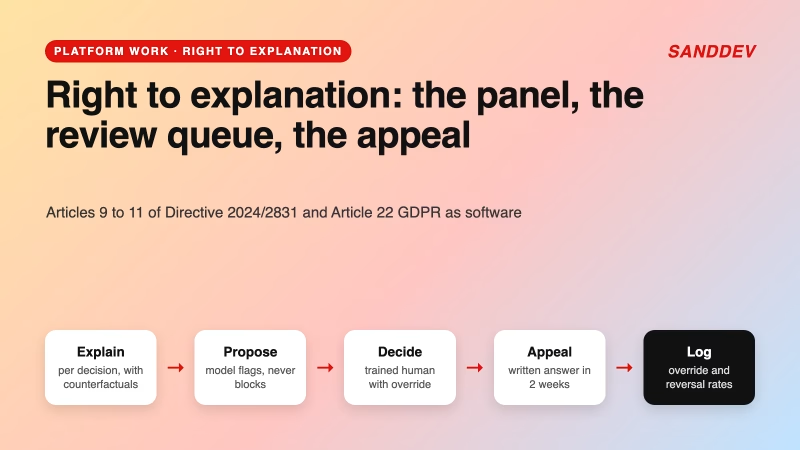
The weakest link is usually the explanation and review path. A driver who was blocked often asks their Uber fleet partner first, because that is where the money comes from. If the fleet partner cannot see the decision, cannot open a review on the driver’s behalf and cannot track the two-week clock, the platform misses its deadline and both companies are on the hook. We cover the full design of that path in our guide to explanations, deactivation appeals and the two-week review deadline.
What data must flow between the platform and an Uber fleet partner’s systems?
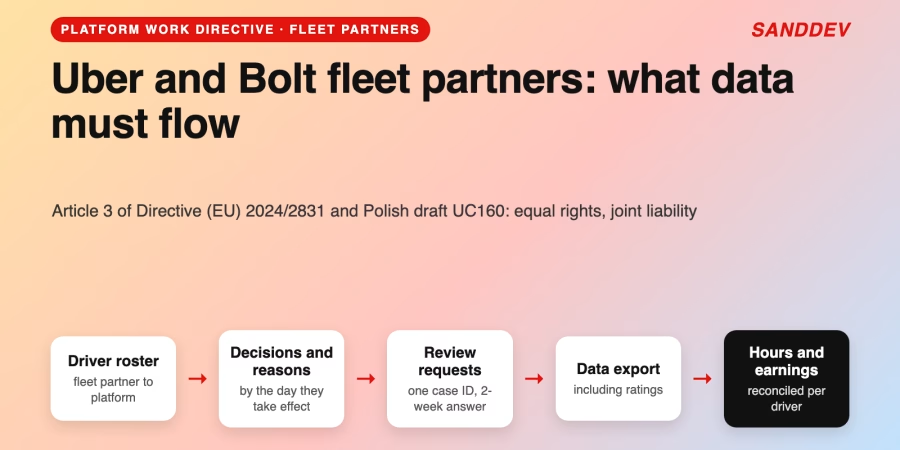
At minimum, five data flows: the driver roster from the fleet partner to the platform, decision events and reasons from the platform to the fleet partner, review requests in both directions with one shared case ID, data exports and transfers, and activity, working time and earnings data for settlements. Each needs an owner, a format and a log.
1. Driver roster and licence status
The Uber fleet partner or Bolt fleet owner sends the platform who is engaged, under which contract type and since when, because joint liability in the draft depends on that notice. The same channel carries licence and document status: the carrier’s licence number and excerpt, expiry dates, and the seven-day notice when a licence is lost or suspended. Uber’s driver requirements for Poland list a Polish driving licence, a criminal record certificate issued within 30 days of verification and medical and psychological examinations, so expiry tracking is not optional.
2. Decision events and reasons
For every automated or supported decision that affects a driver of that fleet (restriction, suspension, termination, refused payment, a rating change with consequences), the platform emits an event: decision ID, driver ID, type, effective time, a human-readable reason, the reviewer who confirmed it and the contact route. The fleet partner stores it, shows it to the driver and to its own staff, and never has to reverse-engineer a block from a drop in payouts.
3. Review requests with one case ID
A review request can start in the driver app, at the fleet partner’s office or through a representative. All three must land in one case with one ID and one timer. The fleet partner’s system forwards the request with its timestamp, receives status updates and the final written answer, and books any rectification or compensation into the next settlement.
4. Data export and transfer
Portability under Article 9(6) covers data generated in the automated systems, including ratings and reviews, and the platform must send it to a third party on request. A driver moving to another Uber fleet partner is the obvious case. The fleet partner needs a way to request the export for a driver with consent, or to receive it directly, in a structured format.
5. Activity, working time and earnings
The directive asks platforms to report the average weekly hours and average income of regular workers (Article 17(1)(c)), and the Polish draft repeats this on request of the labour inspectorate or representatives (Article 7(3)). Hours online, hours on trips, gross fares, platform fees and payouts sit partly with the platform and partly with the fleet partner. If an inspector rebuts or confirms an employment presumption, these numbers are the evidence, so both sides should reconcile them per driver and per week.
What fleet partner software must do: onboarding, documents, settlements and payouts
Fleet partner software, whether you are an Uber fleet partner or a Bolt fleet owner, has to do four things well: onboard drivers with the right information, keep licences and documents valid, settle and pay out with an explanation for every deduction, and act as the driver’s front desk for platform decisions. Most fleets run this on spreadsheets and a messaging app, which leaves no audit trail.
Onboarding. Deliver the platform’s concise transparency information no later than the first working day and record the version and time of delivery; collect consent for data transfers; register the driver with the platform and store the confirmation.
Documents. Track licence excerpts, driving licences, criminal record certificates and medical checks with expiry dates and alerts; keep the history, since the transport act requires records for five years.
Settlements and payouts. Import platform statements, apply the fleet’s fees and deductions, and store a reason for each line. If your own software automatically withholds or reduces a payout, treat it like the platform’s refused payment decisions: a human signs off and the driver gets the reason in writing.
Driver front desk. Show the driver every platform decision, open review requests, show the deadline, and route questions to the platform’s contact person.
Your own monitoring. If you track vehicles or rate drivers yourself, the same limits apply in spirit: no location after the shift ends, no reading private chats, no inferred health or union activity. The equal protection promise and joint liability make this your problem too.
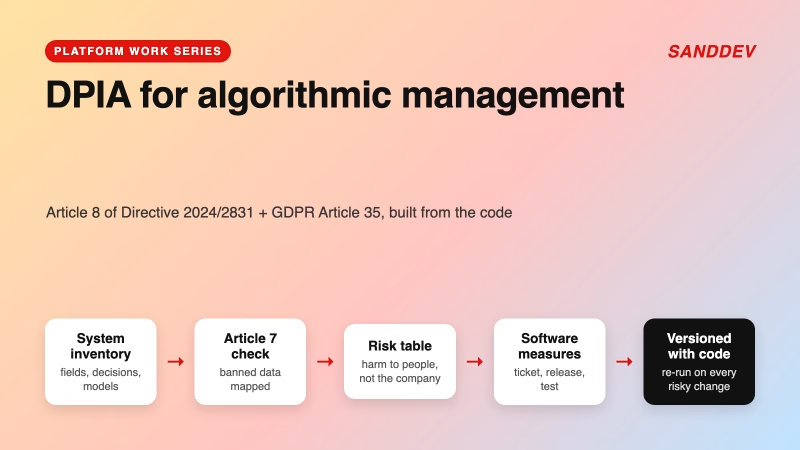
Data protection roles need to be settled in the same contract. Where the platform and the fleet partner jointly decide why and how driver data is processed, Article 26 of the GDPR requires an arrangement that sets out their responsibilities, in particular for data subject rights. The impact assessment that Article 8 of the directive makes mandatory should cover the data exchange itself; our DPIA guide for algorithmic management shows how to build it from a data inventory.
Integration patterns between the platform and fleet partner software
Platform intermediaries connect in one of four ways, and the choice decides whether you can prove a deadline was met. Webhooks or an event feed with an audit log work best; nightly files are acceptable for settlements but not for decisions and reviews, where the clock starts on receipt.
Pattern
Latency
Audit trail
Good for
Event webhooks from the platform, signed and retried
Seconds
Strong if both sides log delivery and acknowledgement
Decisions, reasons, review status
REST API polled by the fleet partner
Minutes
Good if every call is logged with its response
Roster sync, documents, statements
Shared case management (one review case, two views)
Real time
Strongest: one record, one timer
Review requests and answers
Nightly CSV or SFTP file exchange
Hours to a day
Weak; partial files and silent failures
Settlements and reconciliation only
Whatever the pattern, define a shared schema with stable IDs for drivers, decisions and review cases; version it; and keep an append-only log on both sides. When a driver says they never received the reasons for a suspension, each company should be able to show the delivery record in minutes.
API and data exchange checklist for Uber fleet partners and platforms
Sign a written agreement under draft Article 50(3) that says, for each right, which side delivers it and through which channel.
Agree GDPR roles and, where you are joint controllers, an Article 26 arrangement.
Send the driver roster from the fleet partner to the platform on every change and store the platform’s acknowledgement.
Exchange licence and document status with expiry dates; alert both sides seven days before and on expiry.
Version the transparency document and record when each driver received which version.
Emit a decision event for every restriction, suspension, termination or refused payment, with reasons and the reviewer.
Use one review case ID across both systems and track the two-week clock from first receipt, wherever the request arrived.
Book rectifications and compensation from closed review cases into the next settlement automatically.
Provide an export and direct transfer of driver data, including ratings, on request.
Reconcile hours online, hours on trips, earnings and fees per driver per week.
Test the data exchange for banned fields: no emotional state, private messages, off-shift location or inferred sensitive data.
Keep append-only logs of every message sent and received, and rehearse answering an inspector’s request from them.
How Sanddev helps platforms and fleet partners
Sanddev is a software house in Wrocław, Poland, with senior engineers only. On the platform side we review how decisions, reasons and review cases reach intermediaries and design the event feed and schema. On the fleet partner side we build custom fleet partner software: onboarding, document tracking, settlements and payouts, and the integration with each platform, with the audit trail that joint liability now demands. We describe what the software does; whether drivers are employees, and of whom, stays with your lawyer.
FAQ
Is an Uber fleet partner covered by the Platform Work Directive?
Yes. A fleet partner that contracts both with the platform and with drivers is an intermediary under the directive. Article 3 requires Member States to give those drivers the same protection as people contracted directly, and the Polish draft act applies its rights to them in full.
Is a Bolt fleet owner jointly liable with Bolt?
Under the Polish draft act UC160, yes, for claims relating to banned data, impact assessment, portability, transparency, human decisions, explanations and review. The platform’s liability applies where the intermediary has a contract with it and has reported the driver. The draft is not yet law.
Why do drivers in Poland need a fleet partner at all?
Since 1 January 2020 the Road Transport Act allows ride-hailing apps to pass orders only to carriers with a passenger transport licence. Drivers without their own licensed company drive under a fleet partner’s licence, which is why Uber asks drivers to find a fleet partner with the necessary licences.
Does this apply to Glovo, Wolt or Uber Eats courier partners?
Yes. The directive covers delivery work as much as rides, and the intermediary rules do not depend on the vehicle. A courier engaged through a partner company has the same algorithmic rights as one contracted directly with the delivery platform.
What data does a fleet partner have to receive from the platform?
At least decision events with written reasons, the status and answer of review requests, the current transparency information for its drivers, data exports on request and the activity and earnings data needed for settlements.
How long does the platform have to answer a review request from a fleet driver?
Two weeks from receipt, in writing, under Article 11(2) of the directive and Article 37(4) of the Polish draft. If the request reached the fleet partner first, the clock should be tracked from that moment.
Does fleet partner software need to change?
Usually. It must store platform decisions and reasons, forward review requests, track document expiry, explain every payout deduction and keep an audit trail. Spreadsheets and chat groups cannot prove that a deadline was met.