Article partially generated by artificial intelligence.
TL;DR: Third-party risk management is now a legal duty for companies covered by NIS2. Supply chain security is one of the minimum risk-management measures in the directive, and it reaches the companies that write, maintain and host your software. In practice that means assessing vendors by criticality, putting security terms in contracts and reviewing critical vendors regularly. In Poland, this sits inside the information security management system required by the KSC Act by 3 April 2027. This article shows how to do it for software houses and freelancers without producing paperwork nobody reads.
Supply chain security is a measure under Article 21(2)(d) of the NIS2 directive.
When assessing suppliers, companies must consider, among other things, the quality of their products and security practices, including secure development procedures (Article 21(3)).
In June 2025, ENISA published technical guidance on the NIS2 measures, including the supply chain security policy.
Third-party risk management under NIS2: what is required?
NIS2 requires essential and important entities to manage cybersecurity risk, and supply chain security is one of the minimum measures. The directive also requires companies to consider the vulnerabilities specific to each direct supplier, the overall quality of suppliers’ products and their cybersecurity practices, including secure development. Each Member State writes this into national law; in Poland it falls under the information security management system (ISMS) required by the KSC Act. For the Polish timeline, see Poland’s KSC deadlines for company applications.
An ISMS is often built on ISO/IEC 27001, but certification is not required by NIS2 and does not replace meeting the law.
Supply chain security: why it covers software vendors
A software vendor often has access nobody else has: source code, production servers, databases and admin accounts. If their security fails, yours does too. So supply chain security covers not only hardware and cloud providers, but also software houses, freelancers and agencies that maintain your websites and applications.
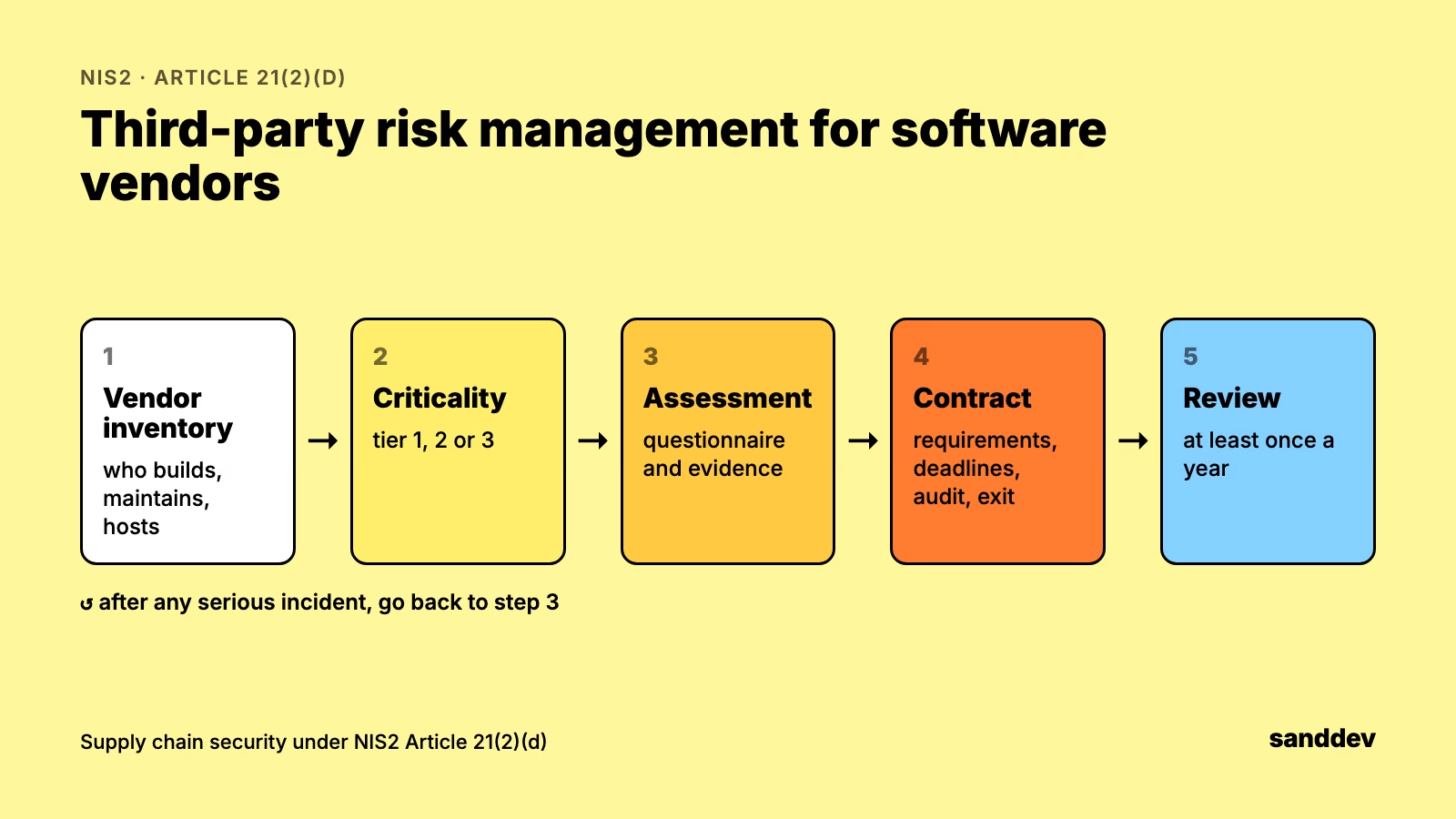
List your software vendors: who built, who maintains and who hosts each application.
Tier them by criticality. A vendor with access to production and customer data needs a deeper assessment than the author of a brochure site.
Send critical vendors a questionnaire and ask for evidence, not just statements.
Assess the answers, record the risks and agree what the vendor must improve.
Review critical vendors at least once a year and after any serious incident.
What to ask a software house: the questionnaire
What does the development process look like: code review, security testing, dependency analysis?
Does the vendor keep an SBOM for the software it delivers?
How quickly does it fix critical vulnerabilities, and how does it inform the client?
How does it manage access to client systems: named accounts, multi-factor authentication, revoking access when work ends?
How quickly will it report an incident on its side to the client?
Does it use subcontractors, and how does it control them?
Where does it store client code and data, and who can access them?
Does the client have full access to source code and documentation?
What to put in a software vendor contract
An assessment without a contract achieves little. A contract with a critical software vendor should cover security requirements for development and maintenance, response times for vulnerabilities and incidents, a duty to report incidents, the right to audit or to receive test reports, rules on subcontracting, handover of source code and documentation, and an exit plan for moving the system to another vendor. The last point is often skipped, and it decides whether you end up with an application nobody can maintain.
How to evidence third-party risk management
An auditor will ask for evidence, not just a policy: a vendor list with criticality ratings, completed questionnaires, review reports, contracts with security terms and a record of actions taken on findings. The strongest evidence is an independent technical review of an application a vendor delivered, because it shows how things really are rather than how the vendor described them. An OWASP Top 10-based checklist is a practical starting point for that review.
Vendor criticality tiers: an example
Not every vendor needs the same attention. Splitting vendors into three tiers focuses effort where the risk is highest.
Tier 1, critical: the vendor has access to production, customer data or the source code of systems the business cannot run without, such as a software house maintaining the ordering system or a company hosting the customer portal. It needs a full questionnaire with evidence, security terms in the contract and a review at least once a year.
Tier 2, significant: the vendor supplies software that matters to operations but has no standing access to production or data, such as the author of a reporting module or a commercial library vendor. A short questionnaire, basic contract terms and a review every two years or when the scope changes are enough.
Tier 3, low: the vendor has no access to systems or data and its product is not critical, such as the author of a brochure website. An entry in the vendor list and standard contract terms are enough.
The tier depends on access and business impact, not contract value. A small freelancer with the admin password to the customer database is a critical vendor, even if their invoice is a few thousand euros a month.
Common mistakes in software vendor assessments
Assessing on statements alone. A questionnaire without evidence such as test reports, policies or a sample SBOM says more about the vendor’s writing skills than about its security.
Skipping freelancers and small vendors because “it’s just one person”. They often have the widest access and the fewest procedures.
No review when the relationship ends. Former vendors’ accounts, keys and VPN access can stay active for years.
A contract with no exit plan. When the work ends, the company discovers it has no source code, documentation or server access.
A one-off assessment. A vendor that was secure three years ago may have changed its team, subcontractors and ways of working since.
Good third-party risk management does not have to be heavy. It starts with a list and a tiering exercise, and deep work is reserved for the few most important relationships. For many mid-sized companies that means a handful of vendors, not dozens, and that is where preparation should begin.
Vendor assessment from a software house’s point of view
A good software vendor does not treat a security questionnaire as an obstacle. Companies that take security seriously have answers ready: a description of their development process, a vulnerability handling policy, a sample test report, an example SBOM and a list of subcontractors. If a vendor needs weeks to answer basic questions or replies in generalities, that is information too.
Also watch how the vendor reacts to a request for source code and documentation. A refusal, or a clause saying the code stays with the vendor and cannot be handed over, means that when the relationship ends you will be left with a system nobody else can maintain. Under NIS2 that is a business continuity risk and belongs in your ISMS risk analysis.
A technical vendor assessment for your ISMS
Sanddev is a software house, so we know these questions from both sides. We help companies assess vendors technically: we review the code and infrastructure of delivered applications, evaluate the development process and prepare findings for your ISMS. See how we provide an independent technical view on your software vendors.
FAQ
What is third-party risk management under NIS2?
Third-party risk management under NIS2 is the duty of essential and important entities to manage the cybersecurity risks posed by their direct suppliers and service providers, including software vendors, as part of supply chain security under Article 21 of the directive.
Does NIS2 supply chain security cover software vendors?
Yes. NIS2 supply chain security covers direct suppliers and service providers, which includes software houses, freelancers and hosting providers that build, maintain or host a company’s software.
Is ISO 27001 certification required for NIS2 supply chain security?
No. NIS2 does not require ISO/IEC 27001 certification. The standard helps build an information security management system, but a certificate does not replace meeting the legal duties or checking how vendors actually work.
How often should software vendors be assessed?
Critical software vendors should be reviewed at least once a year and after any serious incident on their side. For other vendors, frequency depends on their importance to the business and the results of the risk analysis.
What should a software vendor contract include under NIS2?
A contract with a critical software vendor should set security requirements, response times for vulnerabilities and incidents, an incident reporting duty, audit rights, subcontracting rules, access to source code and an exit plan for handing the system to another vendor.