

- AdTech
- AI
- MarTech
- Software Engineering
Sanddev Best Tech Stack – Technologies We Built With
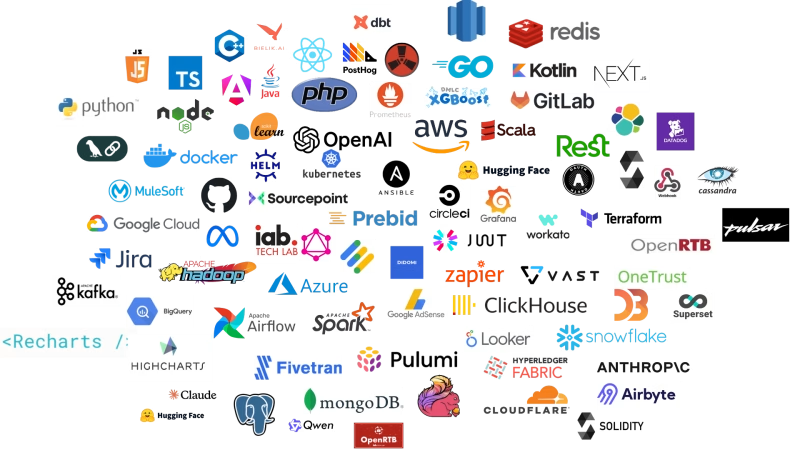
Most agency websites answer “what do you work with?” with a wall of logos. Ours did too. So here is the same wall, written out.

TL;DR: The hardest problems in AdTech and MarTech infrastructure are structural, not feature-level. Real-time systems buckle under AI-era workloads, data pipelines stay expensive and fragile, the identity and consent layer needs constant rebuilding against shifting laws, measurement quietly decays, and integration debt swallows budgets. Fix the plumbing first because features bolted onto broken infrastructure just fail faster and cost far more. If you are earlier than that, start with how an AdTech stack is put together, this post assumes you already have one.
The real problems in AdTech and MarTech infrastructure live in the plumbing, not the product. The same five failure modes keep resurfacing across independent industry reporting: latency-bound real-time systems, brittle data pipelines, a privacy layer that never sits still, silently degrading measurement, and integration sprawl. None show up in a feature demo, all decide whether it survives production.
There is a difference between future-proofing without over-buying and replacing the stack every eighteen months.
They break because they were built for a workload that no longer exists. Programmatic bidding gives a system under 100 milliseconds to price and answer a bid, and timed-out auctions lose revenue. Stacks built around 2022 assumed stateless microservices, not GPU-backed AI inference, so they now hit scheduling instability and latency spikes at peak traffic. Beneath them, pipelines must ingest events on the fly to stay fresh for bidding – expensive and unforgiving.
Teams usually ask whether a shared ledger helps at this point. Usually not. Not never.
Because the ground keeps shifting under it. Google didn’t kill the cookie – it retired most Privacy Sandbox APIs in October 2025 and handed the choice to users instead. Safari and Firefox still block third-party cookies outright, and Global Privacy Control is now legally binding in twelve US states. So teams keep rebuilding consent flows, server-side signal propagation, and first-party identity against rules that shift every quarter.
Measurement degrades because its data erodes silently while the dashboards still look green. Ad blockers and tracking prevention strip client-side tags on more than 40% of sessions in key markets, so attribution drifts one lost event at a time. The trust gap stings: 87% of marketers call data critical, yet only 32% trust their own. Left unpatched, these gaps burn 20–30% of marketing budgets on misallocated spend.
Integration debt drains the budget because every connector you bolt on is one more thing that breaks. The market ballooned to over 15,000 martech tools by 2025, and firms running 20-plus of them spend roughly 40% of their martech budget fixing integrations. Only 17% say their stack components work extremely well together, while technical debt quietly eats 20–40% of IT budgets – cash spent keeping the lights on.
Fix the foundation before you touch the features. At Sanddev we treat AdTech and MarTech infrastructure as an engineering problem first: latency budgets and load-tested real-time paths, pipelines that fail loud not silent, server-side consent and identity so a new law is a config change not a rewrite, measurement checked against ground truth, and integrations consolidated to kill debt at the root. Durable plumbing beats a shiny feature on a shaky base, every time. On the commercial side that is right-sizing and autoscaling planned before the next traffic peak rather than after it.
Most agency websites answer “what do you work with?” with a wall of logos. Ours did too. So here is the same wall, written out.

SAP Marketing Cloud is down and Emarys in not only one in the marketing automation market – see our comparion

Time to go! SAP Marketing Cloud support ends December 2026, roughly four months away. Are you ready to implement new tool?