

- AdTech
- AI
- MarTech
- Software Engineering
Sanddev Best Tech Stack – Technologies We Built With
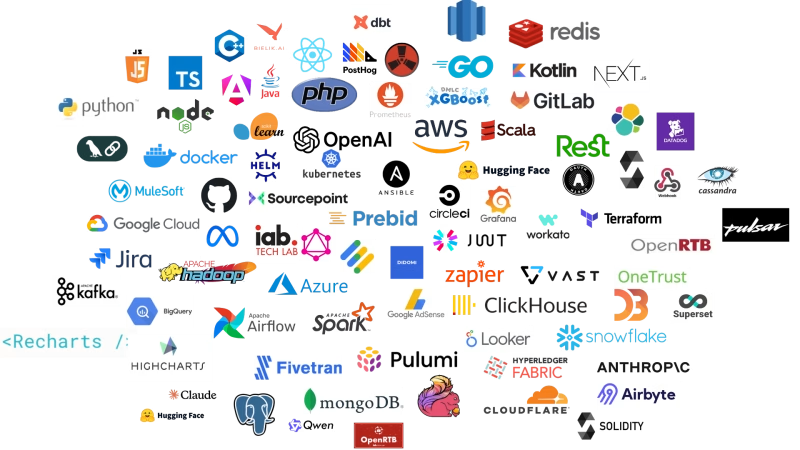
Most agency websites answer “what do you work with?” with a wall of logos. Ours did too. So here is the same wall, written out.

Article partially generated by artificial intelligence.
You know that feeling when you see a competitor’s campaign go viral and wonder, “What did I miss?” You’re not alone. Tech FOMO is real. By the time you’re reading this, someone in your competitor’s boardroom is already discussing blockchain-backed identity, AI-powered attribution, or serverless real-time bidding. And if your tech stack still smells like 2018, you’re not just behind – you’re invisible.
Let’s face it. Advertising technology changes fast. Over 60% of marketers admit they worry about falling behind on new tech. If you’ve ever scrambled to Google a new term in a meeting or felt anxious about missing the next big thing, you’re in good company. The fear of missing out (FOMO) can keep you up at night, but it doesn’t have to run your strategy.
But don’t panic. (Well, panic a little, and before you buy anything new, it helps to know what running ad infrastructure actually involves.)
AdTech moves at a dizzying pace. New tools, privacy rules, and AI-powered features seem to pop up every week. You worry that if you don’t jump on the latest trend, you’ll fall behind and disappear like a failed meme. But chasing every shiny object isn’t just exhausting. It can leave your team with a bloated tech stack, wasted budget, and a nagging sense that you’re always a step behind.
Tech FOMO is a real, measurable source of stress for marketing teams. Tech FOMO motivates not just consumers but marketers too. When every headline screams about the “next big thing,” it’s easy to feel like you’re the only one not in on the secret.
But here’s the truth. Nobody has it all figured out. The smartest marketers aren’t the ones who chase every trend. They’re the ones who build a foundation that can handle whatever comes next.
The world of advertising technology can feel like a never-ending game of whack-a-mole. In 2026, the landscape is more crowded and more confusing than ever – tech FOMO overwhelms. New platforms, privacy laws, and data strategies pop up constantly. One day, you’re told to double down on programmatic audio. The next, it’s all about first-party data or the latest AI-powered targeting.
MarTech and AdTech are merging. The lines between marketing technology and advertising technology are blurring. Today’s winners are the brands who can orchestrate messages across every channel, not just buy ads in silos.
The chaos is real, tech FOMO is real but so is the chance to build something that lasts.
With every new tool promising “revolutionary” results, how do you separate real value from vaporware? Here’s a gut-check you can use.
One line item passes this test almost every time, because what invalid traffic is actually costing you can be measured before you spend anything on fixing it.
Breaking the cycle of tech FOMO and building a stack that lasts starts with a little honesty and a lot of planning. It begins with a close look at your current stack. You need to know every tool, platform, and integration you use (I feel a headache just thinking about it). But think about what’s working, what’s gathering dust, and where the gaps are. Sometimes the hardest part is admitting what’s not delivering.
If the dust turns out to be expensive, cloud spend analysis broken down by service and by team is the same exercise with numbers attached.
Most agency websites answer “what do you work with?” with a wall of logos. Ours did too. So here is the same wall, written out.

SAP Marketing Cloud is down and Emarys in not only one in the marketing automation market – see our comparion
Time to go! SAP Marketing Cloud support ends December 2026, roughly four months away. Are you ready to implement new tool?