

- AdTech
- AI
- MarTech
- Software Engineering
Sanddev Best Tech Stack – Technologies We Built With
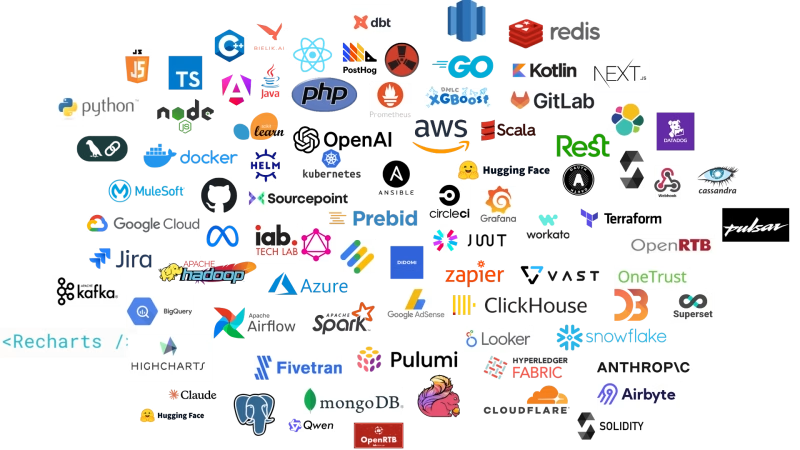
Most agency websites answer “what do you work with?” with a wall of logos. Ours did too. So here is the same wall, written out.

In today’s digital-first world, identity is everything – nothing new. But especially in AdTech and MarTech, where user data drives targeting, personalization, and conversion. But how that identity is managed can make all the difference.
Two primary models dominate the conversation: centralized vs. decentralized identity. While both aim to authenticate users and manage access, they differ fundamentally in control, privacy, scalability, and security. In this article, we’ll break down what centralized vs. decentralized identity mean, compare their pros and cons, and help you determine which model best suits your business goals. Which model is for you: whichever you pick, the legal frame around both models is the same set of obligations.
Think about how most websites and apps work today. Whatever you work, you are also a user. You sign up with your email or social media account, and your details go into a big company database. That company controls your data. If there’s a hack or a mistake, your information could end up in the wrong hands. You might not even know who has access to it or how it’s being used.
Now, picture a different approach. With decentralized identity, you are the one in charge. Your information is stored on your device, not in a giant company database. When you need to prove something about yourself – like your age or your membership – you show only what’s needed. You don’t have to give away your whole life story.
In a centralized system, a company or authority holds your data and decides how it’s shared. You have to trust them to keep it safe and use it responsibly. If they get hacked, everyone’s information is at risk.
In a decentralized system, you keep your own data. You choose what to share and when. There’s no single place for hackers to attack, and you don’t have to trust a big company with your details. Instead, you trust the technology, which uses strong security and clear rules to protect your privacy. However, of course there are disadvantages of decentralized identity. Before you commit to the decentralised side, read the trade-offs nobody puts in the pitch deck.
| Area | Centralized Identity | Decentralized Identity |
| Definition | Refers to systems where a single authority (eg. Google, Facebook) manages and controls user identities and authentication processes. | Also known as self-sovereign identity (SSI), gives users full control over their digital identities using blockchain or distributed ledger technology. |
| How it works | Users register and log in through a central provider.Then, identity data is stored on centralized servers. Provider control access to permissions. | Users create and manage their own unique identifiers, which are stored locally or on decentralized networks.Then, users selectively share verifiable credentials without exposing unnecessary information. |
| Examples | Logins (Sign in with Google), SSO (Single Sign-On) systems, traditional CRM customer profiles | In this case technology: Blockchain (e.g., Ethereum, Hyperledger), Verifiable Credentials (VC, W3C standard), decentralized identifiers (DIDs) |
| Advantages | Easy to implement and scale, simpler regulatory compliance (data resides in known locations), established infrastructure with mature tools and integrations, familiar UX. | Users control their data and decide what to share.No single entity stores or monetizes sensitive data.Immutable records prevent identity theft and spoofing. Portability: users can reuse credentials across platforms securely. |
| Disadvantages | Insecurity (data breaches can compromise millions of identities at once), lack of user control, data owners collect and monetize user data, limited portability (users must re-authenticate across platforms). | Complex UX – managing cryptographic keys and wallets can be challenging for non-tech users. Lack of universal standards can hinder integration. Blockchain-based systems may suffer from low throughput and latency. Lost keys = lost identity, with no centralized recovery option. |
Who reads it about centralized vs. decentralized identity and understands everything? Hand up!
Ok, joke. But let’s see simpler comparison:
| Area | Centralized Identity | Decentralized Identity |
| Control | Managed by a central authority | Controlled by the user |
| Data ownership | Owned by the platform | Owned by the individual |
| Security | Vulnerable to breaches | Resilient against attacks |
| Privacy | Risky and reactive | Consent baked in with zero-knowledge proofs |
| Regulatory Compliance | Easier to enforce | Still developing frameworks |
| Data activation | Walled gardens, limited control | DID empowers clean rooms and open ecosystems |
| Ad fraud & spoofing | Easy to fake IDs | Verifiable credentials prevent impersonation |
| Vendor lock-in | Proprietary ID graphs | DID is interoperable across ecosystems |
| Cross-device identity | Cookie syncing (inaccurate) | DID is user-centric & device-portable |
| User Experience | Simple and familiar | Complex and evolving |
| Use case fit | B2C apps, enterprise IAM | Privacy-first marketing, Web3, digital credentials |
Now clearer? Perfect.
Now, we know what centralized vs. decentralized identity looks like for users. Let’s see what it means for your company. The model – centralized vs. decentralized identity – you choose can have a key impact on your business. Still don’t know which fits your strategy?
No problem. Cards on the table.
The choice centralized vs. decentralized identity depends heavily on your business goals, target audience, and compliance requirements.
But the joke is that perhaps the market will be forced to launch decentralized identity anyway. It won’t be day by day, but naive people would not be prepared.
So, what’s about hybrid models, at first?
Many forward-thinking enterprises are adopting hybrid identity models, combining the scalability of centralized systems with the privacy and control of decentralized ones. Think of it like a mullet: business in the front (centralized), revolution in the back (decentralized).
For example you can use decentralized identifiers for user consent and preference management, leverage centralized systems for internal access control and analytics and allow users to opt-in to self-sovereign identity for enhanced privacy features. This approach ensures flexibility, future-readiness, and alignment with evolving consumer expectations around data ownership.
Let’s make an exercise and see how it can work in action centralized vs. decentralized identity: loyalty + ads:
So, you don’t have to burn the castle to build a bridge. A hybrid identity model centralized vs. decentralized identity lets you keep the structure -while giving the people the keys.
Centralized vs. decentralized identity models each offer unique strengths and neither is universally superior. In the evolving landscape of AdTech and MarTech, the key is to understand your audience, use case, and long-term strategy before choosing one over the other – or combining them into a hybrid solution.
As privacy regulations tighten and consumers demand more control over their data, decentralized identity will play an increasingly important role – but only when implemented thoughtfully alongside proven centralized capabilities.
Let us help you navigate the complexity and build the right identity foundation for your digital transformation journey. If you want to see it as an engineering scope rather than an offer, consent frameworks, identity graphs and post-cookie identifiers is what that turns into on our side.
The theory is neutral; the consequences are not. We looked at what this changes for advertisers specifically.
Also, an interesting comparison centralized vs. decentralized identity you can find in Identity.
Most agency websites answer “what do you work with?” with a wall of logos. Ours did too. So here is the same wall, written out.

The hardest problems in AdTech and MarTech infrastructure are structural, not feature-level. Read why and how to solve it.

AI vs ML isn’t semantics. Machine learning is the AI subset that predicts outcomes from data: it runs bidding, targeting, and fraud detection.